How Much Does It Cost to Build a SaaS With AI in 2026?
Orkosi Team · · 10 min read

The cost to build a SaaS with AI in 2026 breaks into five lines: the AI tool's subscription, which runs from free to a few tens of dollars a month on the generators; hosting, which on AWS pay-as-you-go is a few dollars to a few tens of dollars a month for a small product; Stripe's per-transaction fees on every payment; a domain at around $10 to $15 a year; and email at cents per thousand messages. A realistic first year for a bootstrapped product lands in the hundreds of dollars plus your hours, against five figures for a freelancer and higher for an agency. Every line is itemised below with its source.

The five lines that make up the cost to build a SaaS with AI
Pricing pages show one number and bills show thirty, so founders either overestimate the cost of running software or forget half of it. The useful model is five lines.
- Tool subscription. What you pay the AI builder or agent platform each month.
- Hosting. Compute, database, storage and delivery for the running product.
- Payments. Stripe's fees, charged per transaction rather than per month.
- Domain. A yearly registration and a small monthly DNS charge.
- Email. Transactional messages (receipts, resets, confirmations) priced per thousand.
A sixth line, your own hours, does not appear on any invoice and is usually the largest. It is covered at the end.
Tool subscription: what the AI builders charge
The entry paid tiers of the chat-based generators cluster around $20 to $25 a month, with free plans that are enough to try an idea. The figures below come from the vendor pages, checked on 2026-10-08.
| Tool | Free plan | Entry paid plan | Source |
|---|---|---|---|
| Lovable | $0 (5 build credits a day) | From $25/month on the Pro plan, monthly allowance of 100 credits | Lovable plans |
| Bolt | $0 (1M tokens a month, Bolt branding) | $25/month on the Pro plan, 10M tokens | Bolt pricing |
| Replit | Starter (free tier named in the docs) | $20/month on the Core plan ($18 billed annually) | Replit pricing |
| Base44 | $0 (25 message credits) | $16/month on the Starter plan, billed annually | Base44 pricing |
| Orkosi | Free plan | See the pricing page | Agent team, hosting and business layer included |
Three things to read into the table. First, credits and tokens are metered, so a month of heavy prompting on a generator can cost more than the headline line; Lovable's higher credit tiers cost more, and Replit charges pay-as-you-go usage beyond the monthly allowance. Second, some vendors publish annual-billed figures only (Base44's monthly-billed price is not public in the page text), so compare like with like. Third, the generators include hosting and a database in the plan, which removes most of the next line for them.
Orkosi sits in a different category: a team of agents builds, tests, reviews and deploys the product, hosting on AWS, a database, Stripe billing, a blog engine and a brand kit are included, and the agents keep working through tasks after launch. There is a free plan; the paid plans are on the pricing page rather than quoted here. The fair comparison is not the subscription line alone but the subscription plus hosting plus the hours you would otherwise spend.
Hosting: AWS pay-as-you-go, line by line
If the AI tool deploys to your own cloud account, or if you take the code from a generator and host it yourself, the running cost is an AWS bill. For a small SaaS it is a few dollars to a few tens of dollars a month, and the pricing pages are public.
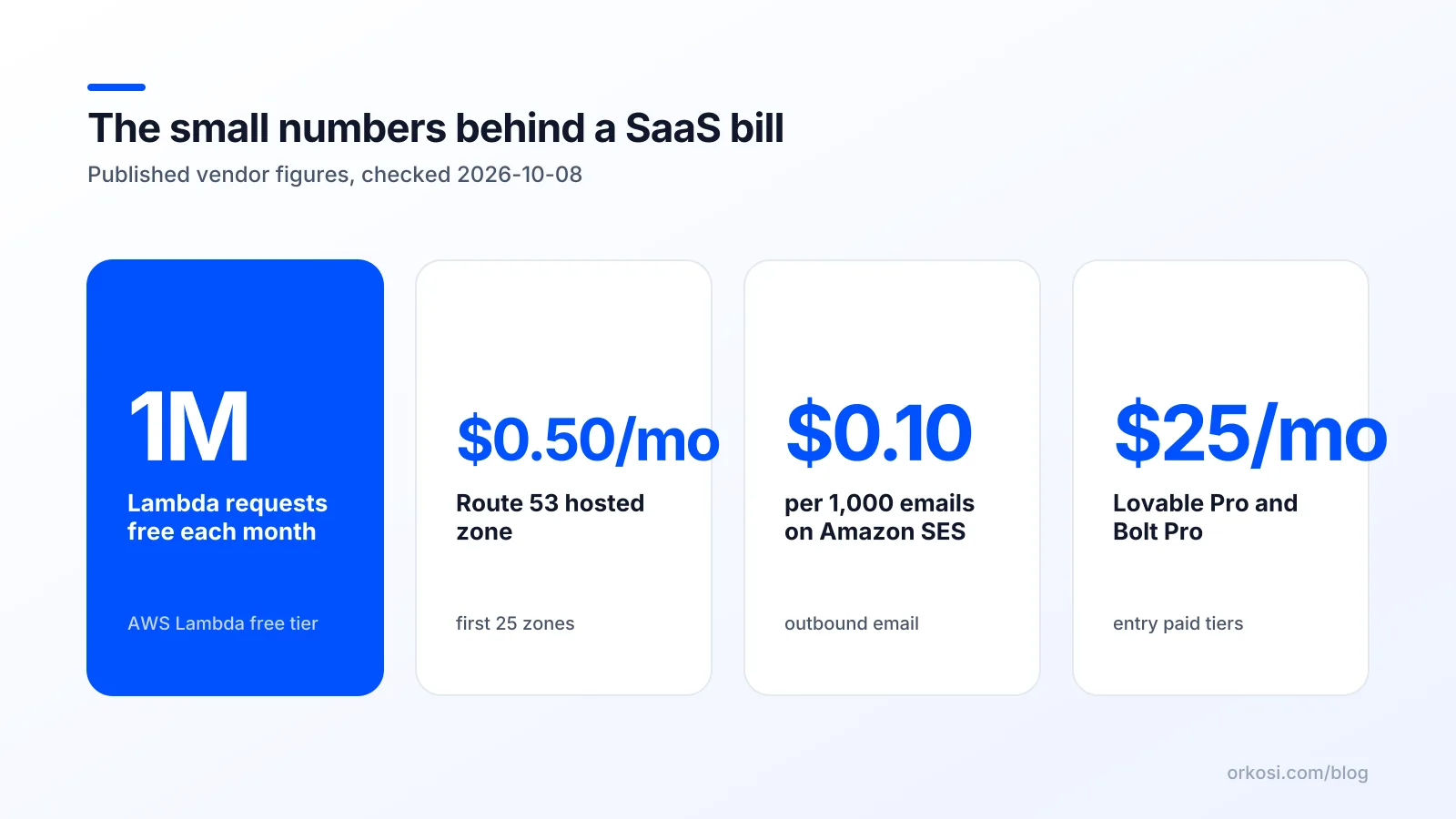
- Compute. A managed container service such as App Runner bills for vCPU and memory while active, with a smaller charge while idle; the model is on the App Runner pricing page. If the backend is serverless, Lambda's free tier covers 1 million requests a month, which is more than a new product uses.
- Database. A small managed PostgreSQL instance on RDS runs to a few tens of dollars a month with backups included; the smallest instance classes are the right choice until you have thousands of users.
- Storage and delivery. S3 charges cents per gigabyte-month and CloudFront has a free tier that covers more delivery than an early product needs.
- Free tier. New accounts get an allowance described on the AWS Free Tier page; read the current terms rather than an old blog post, because the programme has changed shape.
The two surprises on an AWS bill are a NAT gateway left running and data transfer out. Neither is needed for a small product if the stack is set up carefully. On Orkosi the hosting is part of the plan and runs on AWS with a dev and a production environment per product, so this line is folded into the subscription; what you give up is the ability to pick instance sizes yourself.
Payments, domain and email
Payments. Stripe charges per successful transaction and publishes the standard rates on stripe.com/pricing. There is no monthly fee for the standard integration. On $1,000 of monthly revenue the fee is a few tens of dollars; on $100 it is a few dollars. It scales with income, which is the right shape for a new product.
Domain. A .com registration is typically $10 to $15 a year at most registrars (our estimate; prices vary by registrar and by ending). If DNS is on AWS, a Route 53 hosted zone is $0.50 a month for each of the first 25 zones. TLS certificates are free on every platform in this article.
Email. Transactional email is priced per thousand messages. Amazon SES lists $0.10 per 1,000 outbound emails, so a product sending 5,000 receipts and resets a month pays about 50 cents. Marketing email through a dedicated tool is a separate decision for a later month; Orkosi includes email marketing in the product, which removes that line for its customers.
Add the three together and a product with its first hundred customers pays roughly a dollar a month for domain and email plus Stripe's cut of revenue. These lines are not where the money goes.
Freelancer vs agency vs AI builder vs AI agent team
The subscription is a small part of the cost to build a SaaS with AI on every route. The honest comparison is against the alternatives founders used before: paying a person. The ranges below are typical figures and our estimate unless a source is linked; a specialist product, a regulated industry or a fixed-price contract will move them.
| Route | First version (typical) | Monthly after launch | Your hours to first version | Who owns the code |
|---|---|---|---|---|
| Freelance developer | $8,000 to $40,000 (our estimate) | $50 to $150 an hour per change (our estimate) | 20 to 40, mostly in meetings | You, if the contract says so |
| Agency | $30,000 to $150,000 (our estimate) | $3,000 to $10,000 retainer (our estimate) | 20 to 40, mostly in meetings | You, if the contract says so |
| AI builder (chat generator) | $0 to $25 a month in subscription | $0 to $50 a month plus credits | 40 to 120, building and testing | You, on the tools with repository sync |
| AI agent team (Orkosi) | Free plan; see the pricing page | Subscription per the pricing page | 10 to 30, specifying and testing | You, in your own GitHub repository |
For a sense of where the human figures come from: the US Bureau of Labor Statistics puts the median annual wage for software developers above $120,000 in its Occupational Outlook Handbook, and a freelancer's hourly rate has to cover that income plus unbilled time, which is why $50 to $150 an hour is typical. An agency adds project management, design and margin on top.
The columns that matter most are the hours and the ownership. An AI builder is cheapest in cash and most expensive in your evenings. A freelancer is the safest route for unusual architecture and the slowest to change. An agent team is the cheapest in founder hours, because the agents build, test and review while you specify and check, and the code sits in your repository from day one.
A worked example: the first year for a bootstrapped SaaS
Take a booking product for independent physiotherapists, launched by one founder with no engineering team. Here is a realistic first year on three of the four routes, with the same product on each, to show the full cost to build a SaaS with AI rather than the subscription line alone.
AI builder. Entry paid plan at $25 a month for twelve months ($300), hosting and database included in the plan, a domain at about $12, Stripe fees on revenue. Cash: about $320 for the year. Hours: 80 to 120 to build and learn, then every change is your evening.
AI agent team. A subscription on a paid plan (the figures are on the pricing page), hosting, database, Stripe billing, a blog and a brand kit included, a domain at about $12, Stripe fees on revenue. Hours: 20 to 30 to specify and test the first version, then a few hours a week writing and approving tasks.
Freelance developer. $12,000 to $25,000 for the build (our estimate), AWS hosting of a few tens of dollars a month that you arrange, a domain, Stripe fees, then $100 to $150 an hour for changes. Cash: $13,000 to $30,000 for the year. Hours: 30 to 60 in briefings and acceptance testing, and a dependency on one person's calendar.
The numbers are not the whole story. The builder route buys cheapness with your time. The freelancer buys certainty with cash and waiting. The agent team sits between them on cash and lowest on hours, with the specific risk that you must learn to write briefs and tasks an agent cannot misread. The feature list shows what the agent route includes so you can compare it with the builder plans line by line.
Hidden costs that do not appear on any pricing page
Your hours. Value them at what your time is worth to the business. At $50 an hour, 100 hours of building on a chat generator is a $5,000 line that never appears on an invoice.
Rework. A product built from a vague spec is rebuilt in month three. The cheapest insurance is a one-page brief written before any tool is opened.
Credit overage. Generators meter credits or tokens; a month of heavy iteration can cost double the headline. Check the overage terms on the vendor page before you depend on the tool.
Migration. If the route you choose does not put the code in your repository, leaving it means rebuilding. The tools in the table above all offer repository sync in some form; check which plan it starts on.
Idle cloud resources. A database or gateway left running at full size is the classic AWS surprise. If someone else operates the hosting, this risk moves to them; if you do, set a billing alarm on day one.
Lovable is a trademark of its owner; Orkosi is not affiliated with it. Bolt is a trademark of its owner; Orkosi is not affiliated with it. Replit is a trademark of its owner; Orkosi is not affiliated with it. Base44 is a trademark of its owner; Orkosi is not affiliated with it.
FAQ
What is the minimum cost to build a SaaS with AI?
Close to zero in cash for a prototype: free plans exist on the generators and on the agent platforms, Stripe has no monthly fee, and a domain is around a dollar a month. The first real cost is the entry paid plan, around $16 to $25 a month on the generators in the table, plus your hours.
How much does hosting cost once I have paying customers?
For the first few hundred customers, a few tens of dollars a month on AWS pay-as-you-go: a small container, a small managed database, storage and delivery. The published pricing pages for App Runner, RDS, S3 and CloudFront give the unit rates. Where the platform includes hosting, the line is inside the subscription.
Is an AI agent team cheaper than a freelancer?
In cash and in hours, for a standard SaaS, yes by a wide margin; the first-version ranges differ by two orders of magnitude. A freelancer remains the right choice for unusual architecture, a regulated domain or a product where a human needs to own the design decisions. The honest answer is to price both routes for your product using the lines above.
What should I budget for the first year?
A bootstrapped founder on an AI route should plan for a few hundred dollars in subscriptions and hosting, a domain, Stripe's share of revenue, and 20 to 120 hours depending on whether an agent team or a chat generator does the building. If you hire a person, plan for five figures.
Want the agent route's number for your product? Create a free account and build the first version from a one-page brief, then check the pricing page for the plan that matches how often you want to ship changes.