How to Build a SaaS MVP With AI Agents in 30 Days
Orkosi Team · · 9 min read
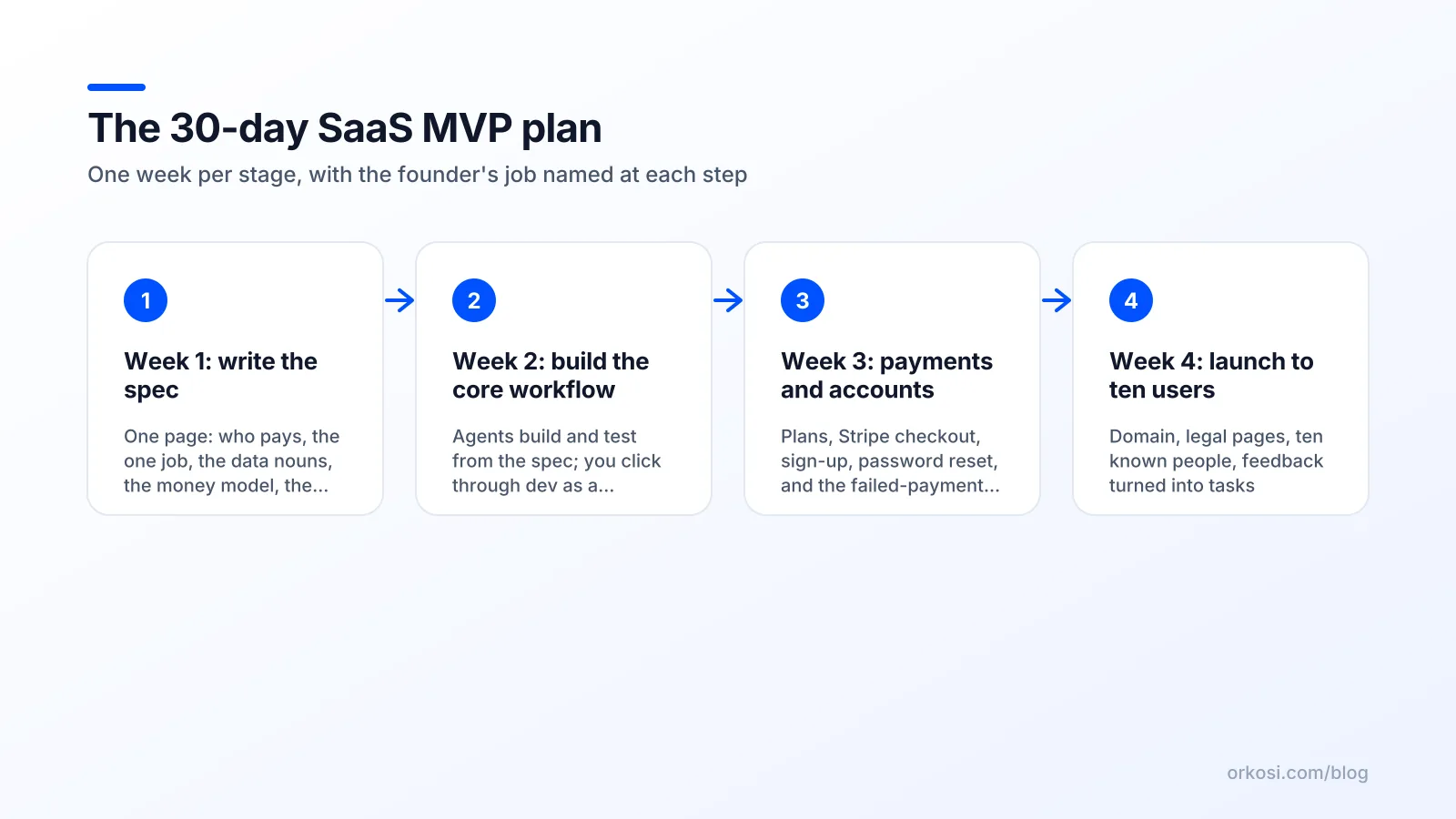
You can build a SaaS MVP with AI agents in 30 days if you spend the first week on the spec, the second on one core workflow, the third on payments and accounts, and the fourth on a launch to ten people you already know. The agents do the building, testing and deploying. Your job is to decide what the product does, test it as a customer on the dev environment, and turn what you learn into tasks. The plan below names what happens in each week, what to cut without regret, and how to tell after ten users whether the idea deserves a second month.

Why 30 days is enough to build a SaaS MVP with AI agents
A SaaS MVP is roughly 70 percent the same as every other SaaS: sign-up, accounts, a plan, a checkout, an admin view, a public page. That 70 percent is exactly what agents build well and quickly, because they have seen it thousands of times. The remaining 30 percent is your one workflow, and that is where the month's attention goes.
The timeline is not aggressive because the agents are fast. It is realistic because the plan refuses to build anything that is not needed for a first paying customer. Thirty days with a strict scope beats ninety days with a roadmap. The constraint is the method.
Here is the month at a glance.
| Week | Goal | Done when |
|---|---|---|
| 1 | A one-page spec the agents can build from | You can read it aloud in two minutes and nobody asks "what do you mean by" |
| 2 | The one core workflow works on the dev environment | You complete the workflow end to end as a customer, twice, without touching the admin |
| 3 | A stranger can sign up, pay and be let in | A test card buys a plan, a declined card is handled, a password reset email arrives |
| 4 | Ten known people use it on a real domain | Ten accounts exist, at least three people did the workflow unprompted, a task list exists |
Week 1: write the spec the agents will build from
Every slow MVP shares one cause: the founder started building on day one. With agents the temptation is stronger, because the first screens appear within hours. Resist it. The spec is the input to everything that follows, and a vague spec produces a confidently wrong product.
Write one page with five parts:
- Who pays and why. One sentence per customer type. "Independent physiotherapists who lose a fifth of their bookings to no-shows" is a spec. "Healthcare professionals" is not.
- The one job. The single workflow someone would pay for on day one. Not the roadmap.
- The data nouns. Customers, appointments, invoices, staff. For each, the four or five fields that matter. This becomes the database schema.
- The money. Flat monthly, per seat or per usage. Decide now, because it shapes the data model and the checkout.
- The not-yet list. Mobile app, integrations, team roles, multiple languages, reports. Written down so you stop thinking about them.
Spend the rest of the week showing the page to five potential customers and rewriting it. On an agent platform such as Orkosi this page is the brief that the agents plan from; the docs describe the shape a brief should take so it cannot be misread. If you start from a SaaS template, say which assumptions of the template you accept and which you want changed.
Week 2: build the core workflow and test it on dev
Hand the spec to the agents on Monday. By midweek there is a dev environment with the data model, sign-in and the first version of the workflow. Your job from that point is testing, not building.
Test as the customer, not as the founder admiring the screens. Create a real-looking account, do the workflow end to end, then do it wrong on purpose: an empty form, a date in the past, two bookings in the same slot, a very long name. Every failure becomes a task with one sentence of acceptance criteria: "Two bookings cannot share a slot; the second attempt shows the next free time."
Keep tasks small. A task that says "make the booking flow better" produces another week of guessing. A task that says "the confirmation page shows the deposit amount and the cancellation deadline" ships in one pass. Where the platform runs automated tests and a review step before each change goes live, as Orkosi does, your tasks are checked twice before you see them; that does not excuse you from testing, it just removes the regressions.
By Friday of week 2 the one workflow should work, twice in a row, without you opening the admin view. If it does not, the spec was too wide. Cut, do not extend.
Week 3: payments, accounts and the boring paths
Week 3 is where a demo becomes a business, and it is where non-technical founders are most often hurt, because the boring paths are invisible until a customer hits them. Demand all of them.
Accounts. Email and password sign-up, password reset, a session that survives a browser restart, and a clear notion of a workspace if more than one person from a company will log in. Get the workspace idea wrong now and you will rebuild the data model later.
Plans and checkout. One plan is enough for an MVP. Use Stripe; the standard fees are on Stripe's pricing page and Stripe Checkout, documented at docs.stripe.com, handles cards, receipts and most tax cases for you. The part most MVPs skip is the webhook: when a payment fails, the account must actually be downgraded. Test it with a declined test card.
Transactional email. Sign-up confirmation, password reset, receipt, and the one email your workflow needs (a booking confirmation, a report ready, an invite). Four templates, no marketing yet.
Legal pages. A privacy policy and terms of service, even plain ones. If you have users in the UK or the EU, the ICO's guidance for organisations is the plain-language reference for what a privacy notice must say.
On Orkosi plans, credits and Stripe subscriptions are part of the generated product, so week 3 is mostly configuration and testing rather than building; on a chat-based generator you will spend the week prompting these paths into existence and testing each one yourself. Either way, the definition of done is the same: a test card buys a plan, a declined card is handled gracefully, and a password reset email arrives within a minute.
Week 4: launch to ten users and turn feedback into tasks
Launch means a real domain with TLS, the production environment separate from dev, the four emails sending, and the public page explaining the product in two sentences. Check the public page against Google's Core Web Vitals; organic search is the only acquisition channel a bootstrapped MVP can afford, and a slow page wastes it.
Then send the link to ten people you have already spoken to. Not a launch post, not a product directory, not strangers. Ten people who said "I would use that" in week 1.
For the rest of the week, watch what they do rather than what they say. Each evening, write down the three most painful gaps, turn each into a task with an acceptance criterion, and ship. The weekly loop that follows (observe, prioritise, task, ship) is the whole of product management for the next six months.
What to cut from the first 30 days
The plan works because of what it refuses. Cut these without regret, and write them on the not-yet list so the decision stays made.
- A mobile app. The web app works on a phone. A store listing is a month-two question at the earliest.
- Team roles and permissions. One owner per workspace. Invite flows come when a customer asks for a second seat.
- Integrations. No Slack, no Zapier, no calendar sync. Export to CSV covers 80 percent of the requests.
- A second plan. One price. You learn more from ten people on one plan than from two people on each of five.
- Reports and dashboards. A list with a filter is a report. Charts come after you know which number matters.
- A marketing site with six pages. One page: what it does, who it is for, the price, a sign-up button.
- Multiple languages, dark mode, custom branding per customer. All real, all later.
If a feature is not needed for one person to complete the one job and pay for it, it is not in the first 30 days. This is also where the decision to build a SaaS MVP with AI agents pays off most: cutting scope costs nothing, because the agents are not idle staff waiting for work.
How to validate with the first ten users
Ten users is a small number, chosen on purpose. It is enough to see patterns and small enough that you can talk to every one of them. Use the four signals below, and be honest about the results.
Did they complete the one job unprompted? Three of ten doing the workflow without a nudge is a good sign. Zero of ten means the job is not as painful as they told you in week 1, or the product makes it harder than their current method.
Did anyone pay with a real card? A free trial that converts one person out of ten is a real signal. Ten trials and no card is a verdict, however warm the feedback.
What did they ask for? Write every request down, then sort by how many people asked. One request from four people is worth more than ten requests from one person.
Did anyone come back on day seven? Return visits in the second week separate a tool from a toy. If nobody returns, the problem is not in the product; it is in the frequency of the job.
At the end of the month you have one of three outcomes. Strong signals on all four: spend month two on the top three requests. Mixed signals: change one thing in the spec (the customer type, the job or the price) and run two more weeks. Weak signals everywhere: stop, and be glad it cost a month rather than a year. The cost of the experiment is the subscription and your hours; the plans are on the pricing page.
FAQ
Can I really build a SaaS MVP with AI agents if I cannot read code?
Yes, provided you can write a precise spec and test as a customer. The agents write, test and deploy the code; the code lives in your own repository so a developer can read it later. The skills that matter in the 30 days are specification, testing and talking to users, not programming.
What if the agents build the wrong thing?
They will, in places, and the fix is a small task with a clear acceptance criterion. The week 2 habit of testing every path on the dev environment is what catches it early. Platforms with automated tests and a review gate reduce regressions, but nothing replaces you clicking through as a customer.
Should I charge from day one?
Yes. A plan with a free trial that requires a card teaches you more in a week than a free product teaches in a quarter. One price, one plan, Stripe checkout, and a declined-card path that works.
What does the first month cost?
The tool subscription (there is a free plan on Orkosi; see the pricing page), Stripe's per-transaction fees, a domain, and your hours. For a bootstrapped MVP the hours are the biggest line, which is why the plan spends them on the spec and on users rather than on building.
Ready to start the 30 days? Create a free account, turn your one-page spec into a brief, and compare plans on the pricing page once you know how many tasks you want to ship in month two.