AI Agents vs Hiring a Developer for Your First App in 2026
Orkosi Team · · 10 min read

AI agents vs hiring a developer comes down to four questions for a first app: how fast you need a working version, how much cash you have, whether you want to own the code, and how unusual the product is. For a standard web app with accounts, billing and one core workflow, an AI agent team wins on speed and cash by a wide margin and matches a good developer on ownership and quality control, provided the platform runs tests and a review step. A human developer is the right call for novel architecture, regulated domains and work that needs judgement the agents do not have yet. Most founders end up with a hybrid.

AI agents vs hiring a developer: the short answer
If your first app is mostly the same as every other app (sign-up, a plan, a checkout, an admin view, one workflow that is yours), agents build it in days for a subscription, and a developer builds it in weeks for five figures. Both can leave you with code in your own repository. The difference in outcome is small; the difference in time and cash is large.
If your first app depends on something unusual (a scheduling algorithm nobody has written, a device integration, a compliance regime with an auditor at the end), a developer's judgement is worth the money. Agents produce confident code; they do not yet produce confident architecture for problems they have not seen.
The rest of this AI agents vs hiring a developer comparison takes the five dimensions one at a time: speed, cost, ownership, quality control and the limits of agents. Then it names when a human is the right call and describes the hybrid most founders settle on.
Speed: days against weeks
An agent team takes a one-page brief and returns a deployed first version in days. The compute does not sleep, the agents work in parallel, and the standard 70 percent of an app (accounts, billing, admin) is the part they have built thousands of times. On a platform such as Orkosi the brief goes in, the agents plan and build, automated tests run, a reviewer checks the result and it deploys to a dev environment you can click through.
A freelance developer typically delivers a first version in six to twelve weeks. Part of that is building; part is calendar. A good freelancer has other clients, a hiring process takes two to four weeks before any code is written, and each round of feedback waits for the next available day. An in-house hire is slower still: recruiting, notice periods and onboarding push the first version into the second quarter.
Speed matters for a reason beyond impatience. The first version exists to be shown to ten users and changed. A route that produces version one in a week lets you run four cycles of feedback in the time the other route takes to produce version one.
Cost: a subscription against a salary or invoice
The ranges below are typical figures and our estimate unless a source is linked. They describe a standard first app, not a specialist one.
| Cost line | AI agent team | Freelance developer | In-house developer |
|---|---|---|---|
| First version | Subscription and hosting (see the pricing page) | $8,000 to $40,000 (our estimate) | Two to three months of salary |
| Annual salary basis | Not applicable | $50 to $150 an hour (our estimate) | Median above $120,000 in the US, BLS |
| Changes after launch | Tasks within the plan | Hourly invoices | Salary continues |
| Hosting | Included on AWS | You arrange, a few tens of dollars a month | You arrange |
| Your hours to first version | 10 to 30 | 20 to 40, mostly meetings | 40 plus, including hiring |
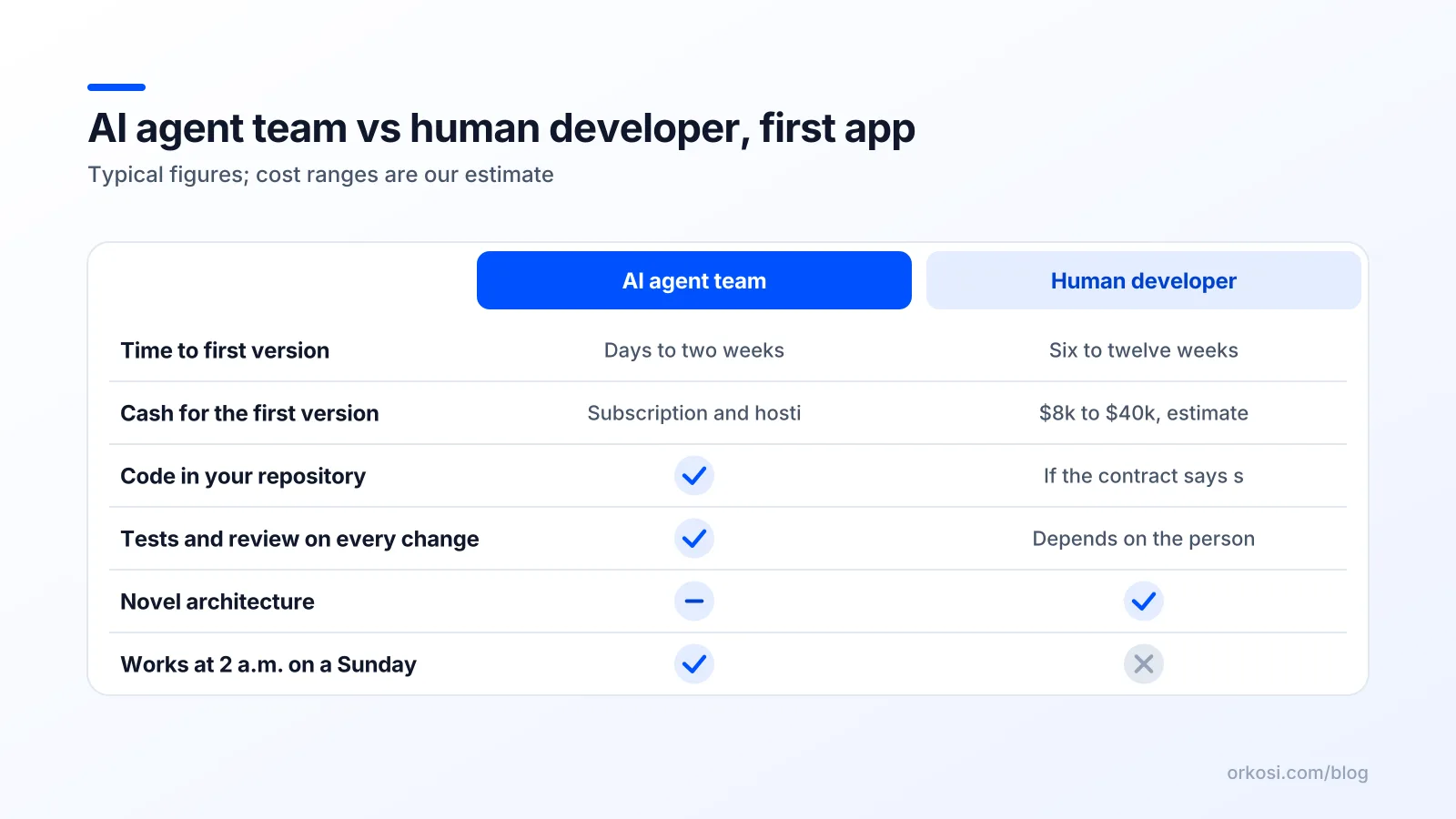
Two notes on the human columns. The US Bureau of Labor Statistics puts the median annual wage for software developers above $120,000 in its Occupational Outlook Handbook, and a freelancer's hourly rate must cover that income plus unbilled time, which is where $50 to $150 an hour comes from. An in-house hire also carries equipment, payroll overhead and the cost of the months before they are productive.
On the agent column the subscription is small, but it is not the whole cost. Add Stripe's per-transaction fees on your revenue, published on Stripe's pricing page, and your own hours writing briefs and testing. The agent route is cheapest in cash and in hours; it is not free of either. Orkosi's plans start free; the paid plans are on the pricing page.
Ownership: who holds the code and the accounts
Ownership has three parts: the code, the infrastructure accounts and the data. A founder should hold all three on either route, and on either route it is possible to end up holding none.
With a developer, ownership is a contract question. A freelancer who writes the code under a contract that assigns the work to you leaves you with a repository you control. A freelancer who hosts the app on their own cloud account and never commits to a repository you can see leaves you with nothing when they move on. Insist on a repository in your name from the first week; GitHub's documentation on collaborating with pull requests is a reasonable description of how the work should flow.
With an agent platform, ownership is a product question: where does the code live, and can you take it? On Orkosi every product has its own GitHub repository, its own dev and production environments on AWS, and a database you can export; a developer can pick up the repository later. Other agent platforms differ, and some generators keep the code inside their editor or export it only on higher plans. Ask before you build, not after.
The data and the Stripe account are the same on both routes: they must be yours. A Stripe account in a contractor's name is a mistake that costs months to undo.
Quality control: tests and review, or trust
Quality control is where the comparison is least intuitive. A developer brings judgement; an agent platform brings process. The two are not the same, and a first-time founder cannot assess either by reading the code.
A good developer writes tests, opens pull requests, reviews their own work and tells you when something should not be built. A less good developer does none of this, and a founder who cannot read code finds out when a customer hits the bug. Quality from a human is only as reliable as the human.
An agent platform with automated tests and a review gate applies the same process to every change: the tests run, a reviewer agent checks the result against the task, and only then does it deploy. That does not make the code better than a strong developer's; it makes the floor higher and the variance lower. On platforms without a gate, the founder is the only tester, and quality falls to whatever the founder notices.
The founder's job is the same on both routes: test as a customer, including the paths that should fail. A declined card, a duplicate booking, an empty form. No process and no person replaces that.
What agents cannot do yet
Honesty here is the whole value of the comparison. Agents in 2026 cannot:
- Invent an architecture for a problem they have not seen. They reuse patterns well. A novel scheduling engine, a real-time multiplayer system or a payments ledger with unusual rules needs a human who has made those mistakes before.
- Hold the context of your business. An agent builds what the task says. A developer who has sat in your customer calls builds what the task means, and tells you when the task is wrong.
- Own security judgement end to end. Automated tests and review catch the common classes of error; the OWASP Top Ten is a useful list of what a review should look for. Threat modelling for a sensitive product still needs a person.
- Sign off for a regulator. Medical, financial and other regulated products need a named accountable engineer, and an agent is not one.
- Negotiate with a third party. An integration partner with a broken API, a payment provider with a compliance question, a data-processing agreement: these are human conversations.
Agents are also only as good as the brief. A vague brief produces a confident, polished, wrong product. The skill that a founder on the agent route must learn is specification; the skill on the developer route is delegation.
When a human developer is the right call
Hire a developer for your first app when one or more of these is true:
- The core of the product is a novel algorithm or system, not a workflow over standard data.
- The product is regulated and someone must be accountable for the engineering.
- You need deep integration with hardware, legacy systems or a partner's private API.
- You already have an engineering lead who will own the codebase and wants a second pair of hands.
- The budget exists and speed is less important than certainty.
Hire a developer later, on top of the agent route, when the product has found its customers and the next step is something the agents cannot do. That is not a failure of the agent route; it is the point at which the product has earned a human.
The hybrid model most founders end up with
The AI agents vs hiring a developer question is rarely settled once. Most founders who start with agents do not stay pure. The pattern that emerges after a few months looks like this: the agents build and maintain the standard product through tasks, and a human developer is brought in, part-time or for a defined piece of work, for the unusual parts.
The hybrid works because the code is in a repository. A developer joining an agent-built product opens the same GitHub repository the agents work in, reads the tests, and takes the pieces that need judgement. Their own tools fit alongside: a developer working in a coding editor such as Cursor, at $20/month (vendor page, checked 2026-10-08) for the Pro plan on Cursor's pricing page, gets an agent inside their editor and automated review of pull requests through Bugbot. That is a developer's tool for a developer's codebase, not a product platform: it does not host the app, run the database or ship a billing layer, which is why it pairs with an agent platform rather than replacing one.
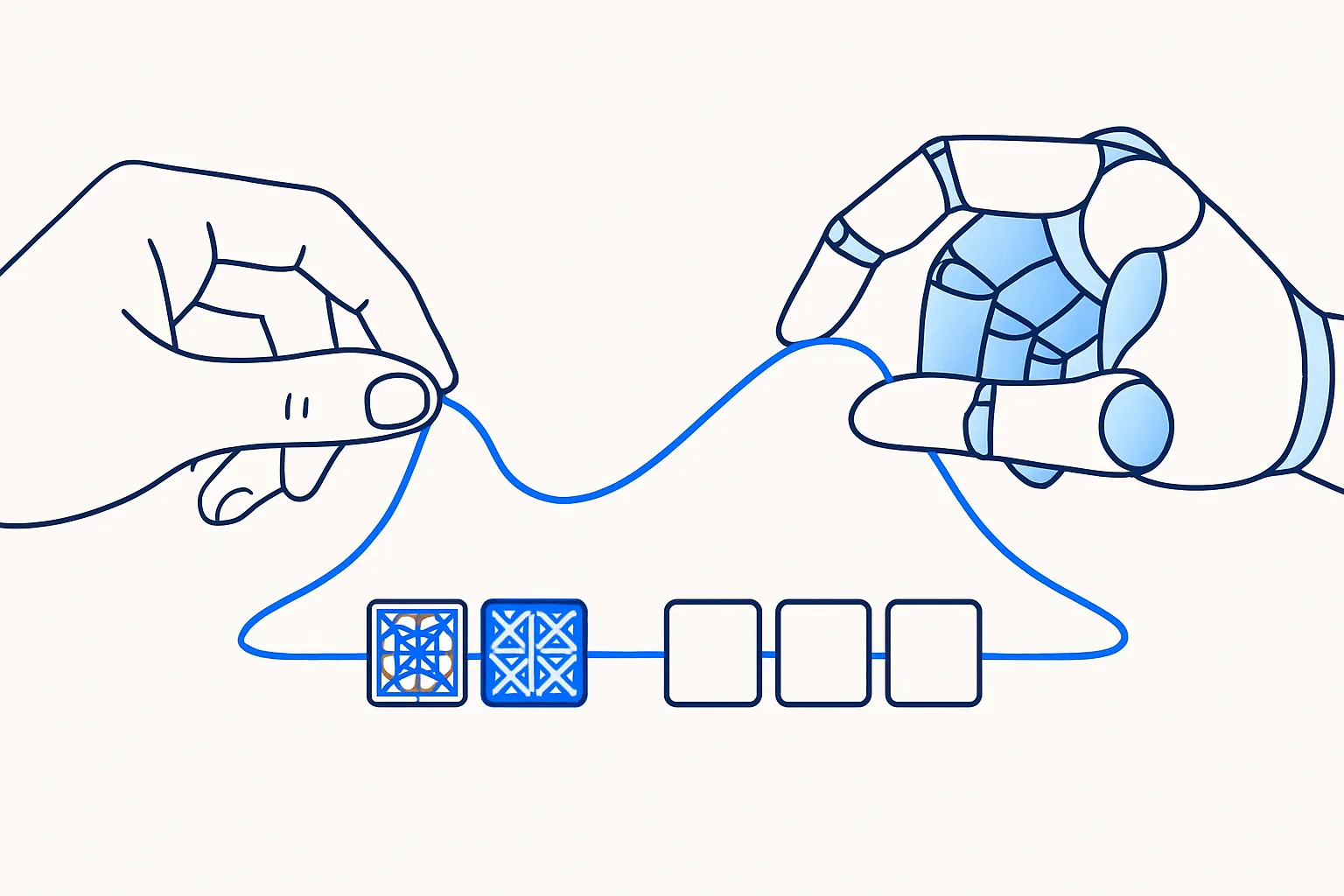
The division of labour in a hybrid is simple to state. Agents take the tasks that are well specified and look like a thousand other tasks. The developer takes the tasks that need a decision, a conversation or an idea. The founder writes both kinds and tests the result. The feature list describes what the agent side covers so you can see which pieces are left for a person, and the docs describe how a developer plugs into an agent-built repository.
Cursor is a trademark of its owner; Orkosi is not affiliated with it.
FAQ
For a standard first app, is AI agents vs hiring a developer even a close call?
Not on speed or cash. For an app made of accounts, billing, an admin view and one workflow, an agent team delivers in days for a subscription while a developer takes weeks for five figures. It becomes a close call when the product needs novel architecture, a regulated sign-off or deep integration work, where a human's judgement is worth the money.
Can a developer take over an agent-built app later?
Yes, if the code is in a repository you own, which on platforms such as Orkosi it is from day one. The developer reads the tests and the task history, and works in the same repository. That is the normal hybrid path once the product has found its customers.
Are agent-built apps secure enough for real customer data?
They can be, when the platform deploys to standard infrastructure with TLS, managed database backups and proper secret handling, and runs tests and review before each change. For sensitive or regulated data, add a human security review against a list such as the OWASP Top Ten. Treat vague answers about where the code and data live as a no.
What is the biggest mistake on each route?
On the agent route, a vague brief; the agents build it faithfully and wrong. On the developer route, an unclear contract about who owns the code, the accounts and the data. Both are fixed before any work starts, with one page of writing.
Want to see the agent side of the comparison for your own app? Create a free account, build the first version from a one-page brief, and compare plans on the pricing page when you know how much of the work needs a human.