What Is an AI Software Factory and How Does It Work?
Orkosi Team · · 9 min read
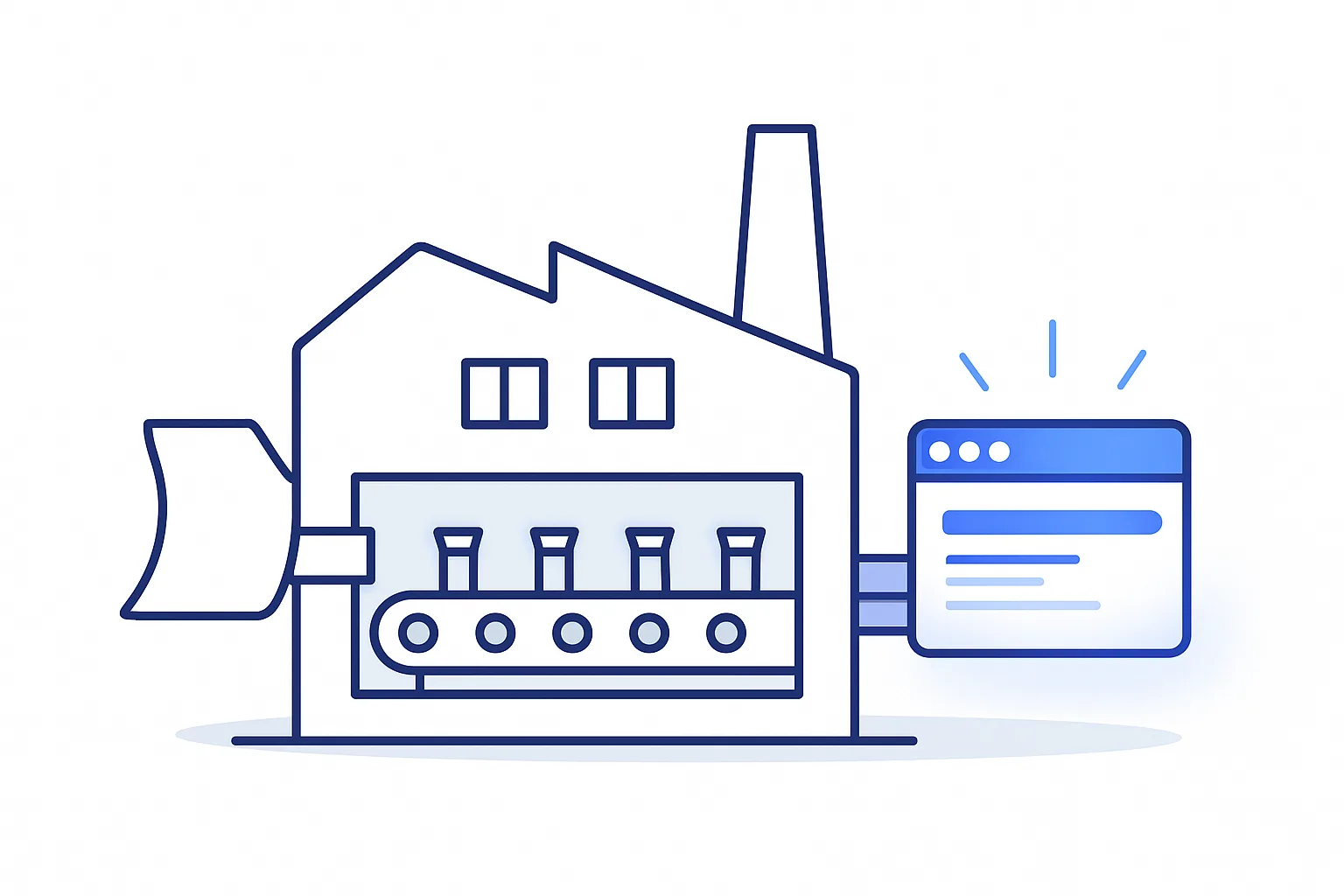
An AI software factory is a pipeline of specialised AI agents that takes a product brief written in plain words and turns it into a deployed, tested software product, then keeps working on that product through tasks after launch. The word "factory" is deliberate: the work is split into stages (brief, plan, build, tests and review, deploy, tasks), each stage has an agent with one job, and nothing reaches customers without passing the stage before it. That is what separates it from a chat window that generates code on demand and from a coding agent that helps a developer inside an editor.

AI software factory: a definition in one paragraph
An AI software factory is a system, not a model. A single large language model can write code; a factory arranges several agents around a model so that writing code is one stage among six, with a planner before it and tests, review and deployment after it. The output is not a code snippet or a preview but a product with a repository, a database, two environments and a domain. The customer is not a programmer prompting the model but a founder who writes the brief, checks the result and approves tasks.
The idea borrows from how good software teams already work. Continuous delivery, as described in Martin Fowler's writing on the subject, is the practice of keeping software in a state where every change can be released safely through an automated pipeline. A factory applies that discipline to agents instead of people: every change, from the first build to a task in month six, goes through the same gate.
The pipeline, stage by stage
The pipeline below is the one Orkosi runs; other factories differ in detail but share the shape.
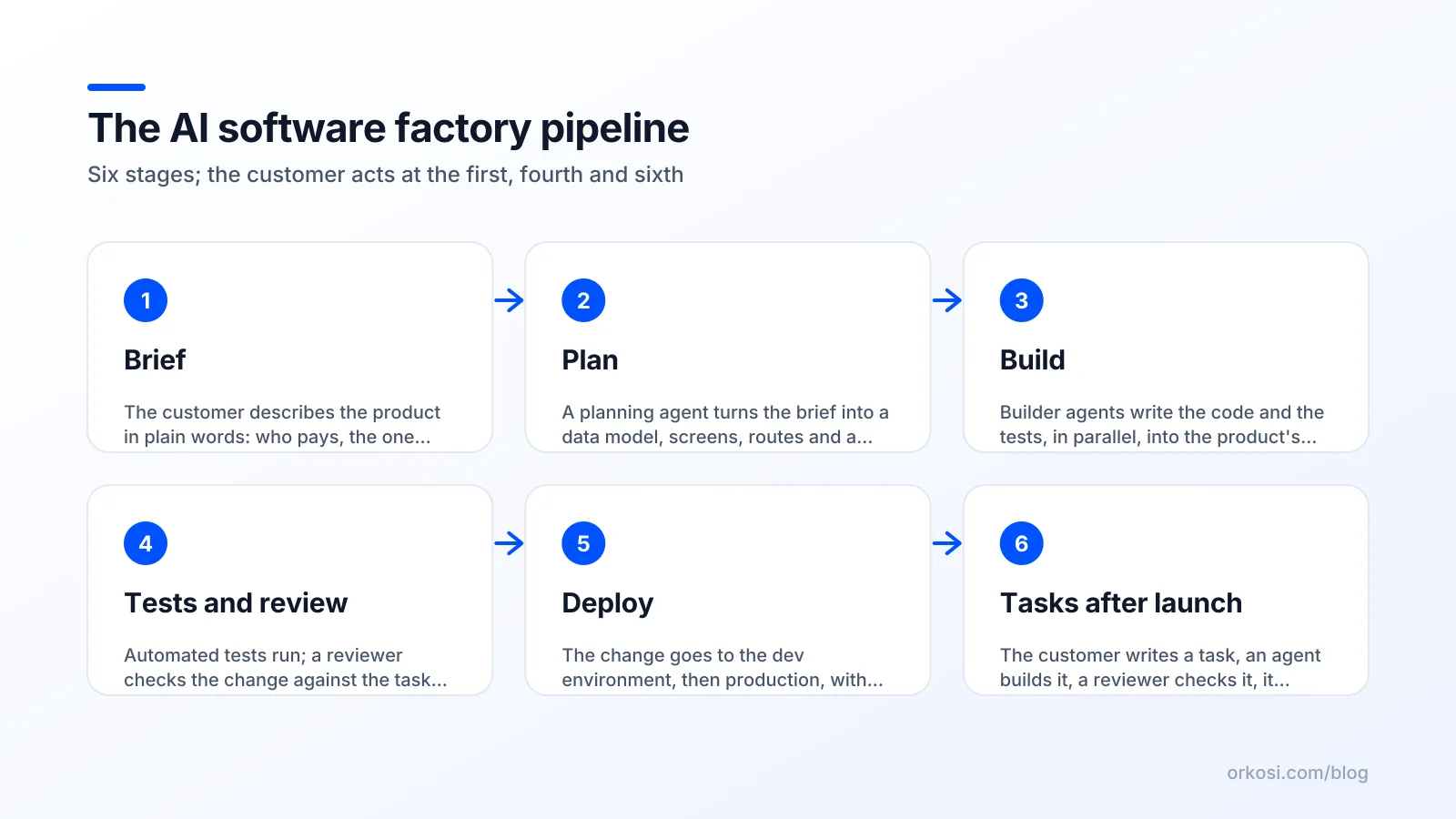
1. Brief. The customer describes the product in plain words: who pays, the one job it does, the data it holds, how the money works, and what is out of scope. A good brief is one page. This is the only input the factory needs and the single biggest influence on what comes out.
2. Plan. A planning agent reads the brief and produces the structure: a data model, the screens and routes, the plan and billing layout, and a list of build tasks in order. The plan is where ambiguity in the brief gets resolved or flagged. A factory that skips planning produces a product that looks like the brief's first sentence and nothing else.
3. Build. Builder agents take the tasks and write the code and its tests, often several tasks in parallel, into the product's own repository. The output is ordinary application code a developer could read, not a proprietary format.
4. Tests and review. The automated tests run. A reviewer agent checks the change against the task it was meant to fulfil, looking for missing cases, broken paths and departures from the brief. A change that fails goes back to the builder with the failure attached. A change that passes moves on. The gate is what makes the next stage safe.
5. Deploy. The change is deployed to the dev environment, where the customer can click through it as a user would, and then to production with TLS and the custom domain. Two environments mean a customer never tests on the same site their users are on.
6. Tasks after launch. The product does not leave the factory at launch. The customer writes a task ("add a 24-hour cancellation window to bookings"), an agent builds it, the reviewer checks it, and it deploys. The loop is the same for the five-hundredth change as for the first.
How it differs from a chat-based generator
A chat-based generator such as Lovable turns a prompt into a web app with a managed backend and syncs the code to GitHub on every plan. It is fast and direct: you type, the screen changes. Its plans are on Lovable's subscription docs, with a Free plan of 5 build credits a day and, from $25/month (vendor page, checked 2026-10-08), the Pro plan with a monthly allowance of 100 credits.
The difference from a factory is not the quality of the generated code. It is what surrounds the generation.
| Dimension | Chat-based generator (Lovable) | AI software factory (Orkosi) |
|---|---|---|
| Input | A prompt per change | A brief, then tasks |
| Who plans the structure | You, prompt by prompt | A planning agent |
| Tests and review before a change ships | No | Yes, every change |
| Environments | Editor preview and a published snapshot | Dev and production |
| Who makes changes after launch | You, per prompt | Agents, per approved task |
| Business layer | Built-in payments on paid plans | Plans, Stripe billing, blog, brand kit included |
| Code in your repository | Yes, two-way sync | Yes, own repository per product |
A generator is the right tool when you want to see something today and are happy to be the planner, the tester and the release manager. A factory is the right tool when you want those roles done for you and are willing to wait a little longer for the first screen in exchange for a gate on every change. The Lovable comparison page puts the full feature grid side by side.
How it differs from a coding agent in an IDE
A coding agent inside an editor, such as Cursor, is a developer's tool for a developer's codebase. The developer opens their own repository, the agent writes and edits code on instruction, cloud agents take on tasks the developer assigns, and Bugbot reviews pull requests. It costs $20/month (vendor page, checked 2026-10-08) on the Pro plan, per Cursor's pricing page, and $40 per user a month on the Teams plan.
Three things distinguish it from a factory. First, the human is the planner and the integrator: the agent accelerates a developer, it does not replace the decisions a developer makes. Second, there is no product around the code: no hosting, no database, no environments, no billing layer; those remain the team's job to arrange. Third, the review is a check on pull requests inside the developer's own workflow, as GitHub describes in its documentation on pull request reviews, rather than a gate the whole pipeline passes through before deployment.
That makes an IDE agent and a factory complementary rather than competing. A founder without an engineering team uses the factory. A developer who later joins an agent-built product can open the same repository with an IDE agent and work alongside the factory's tasks. The Cursor comparison page sets out the grid in detail.
What the factory ships with the code
The reason a factory produces a product rather than a prototype is that the stages after "build" are only useful if there is somewhere to deploy to and something to charge with. In Orkosi's case each product comes with:
- Its own GitHub repository, owned by the customer.
- A dev environment and a production environment on AWS, with TLS and a custom domain.
- A PostgreSQL database.
- Plans, credits and subscriptions through Stripe.
- A blog engine, a brand kit, email marketing and SEO tooling.
- Mobile apps generated as Expo projects, with app-store submission planned rather than available today.
None of this is unique to a factory in principle; a developer can assemble each piece. The point is that the pipeline assumes they exist, so a task that touches billing or the blog is as routine as one that changes a button. The full list is on the features page; there is a free plan, and the paid plans are on the pricing page.
What the customer does in a factory model
A factory removes building, testing and deploying from the founder's week. It does not remove deciding. The customer acts at three points in the pipeline, and the product is only as good as those three.
Write the brief. One page, specific about who pays and what the one job is, explicit about what is not in the first version. The planning agent resolves small ambiguities; it cannot resolve a brief that has not decided what the product is.
Test on dev as a customer. When the first version lands on the dev environment, the founder's job is to use it the way a customer would, including the paths that should fail: a declined card, a duplicate booking, an empty form. Every problem becomes a task with one sentence of acceptance criteria.
Write and approve tasks. After launch, the founder's work is a task board. Each card is a small, testable change. The factory builds, reviews and deploys; the founder decides what goes on the board and confirms the result.
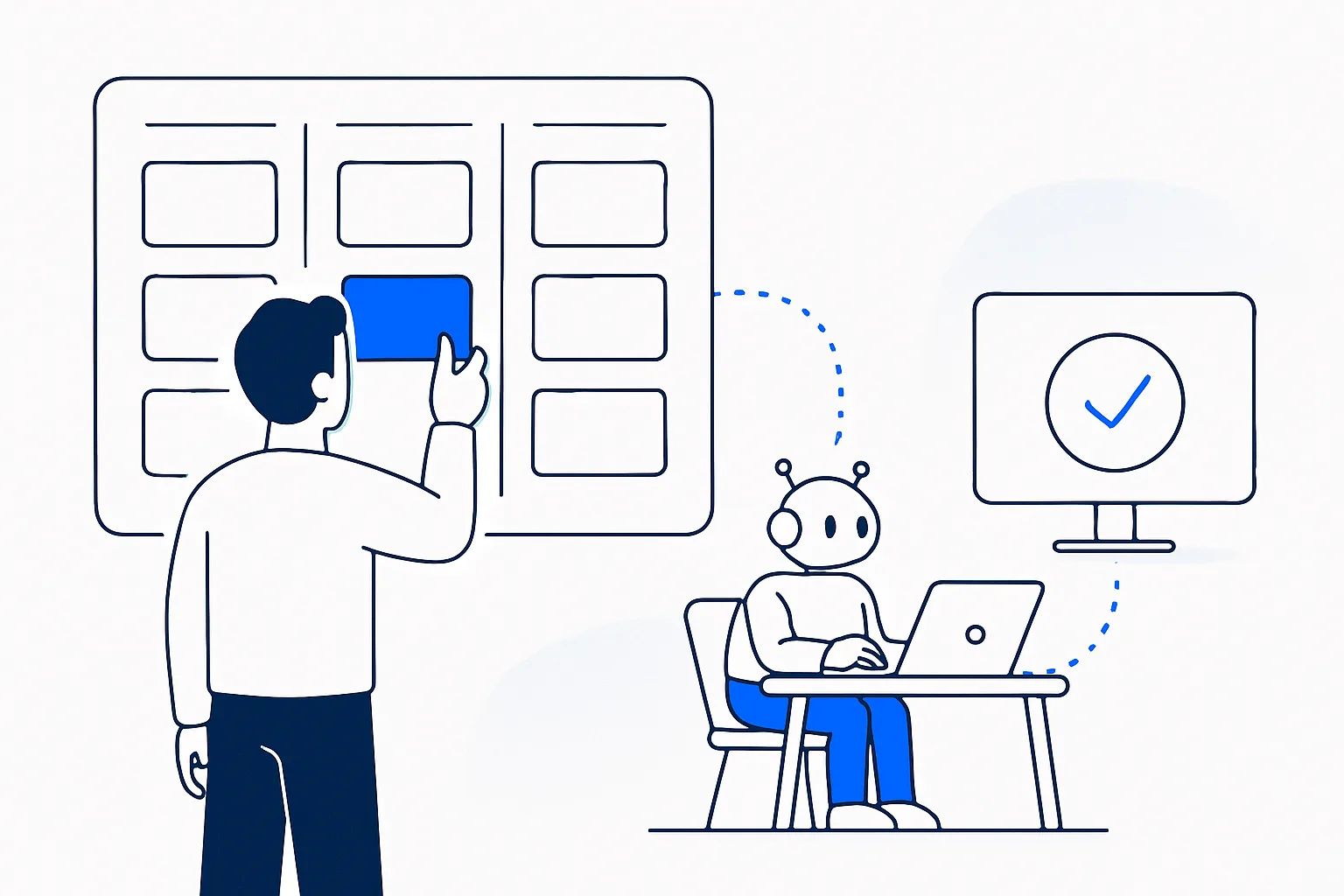
The skill a founder learns in a factory is specification. A task that says "make the booking flow better" produces a guess. A task that says "the confirmation page shows the deposit amount and the cancellation deadline" produces a change that passes review on the first try. The docs describe the shape of a brief and a task that the agents will not misread.
Limits of an AI software factory
A factory is a strong default for standard products and an honest description should say where it stops.
- Novel architecture. The agents reuse patterns they have seen. A product whose core is a new algorithm, a real-time system or an unusual ledger needs a human engineer for that core, with the factory handling the rest.
- Business context. The factory builds what the task says, not what it means. A developer who has sat in your customer calls will sometimes tell you the task is wrong. A factory will build it faithfully.
- Security judgement. Tests and review catch common classes of error, and a review that follows a list such as the OWASP Top Ten catches more. Threat modelling for a sensitive product still needs a person.
- Regulated sign-off. Medical, financial and similar products need a named accountable engineer. A pipeline is not one.
- Pixel-level control. A visual builder lets you drag a button two pixels left. A factory lets you write a task asking for it, which is slower for that kind of change.
- Mobile store listings. Expo apps are generated, but store submission is planned, not shipped. A founder who needs a store listing this month should choose a tool that publishes today.
The factory is also only as good as the gate. A pipeline that skips the tests and review stage is a generator with extra steps, and a founder choosing between platforms should ask exactly what runs between "build" and "deploy".
Lovable is a trademark of its owner; Orkosi is not affiliated with it. Cursor is a trademark of its owner; Orkosi is not affiliated with it.
FAQ
Is an AI software factory the same as an AI app builder?
No. An app builder generates code from prompts and leaves planning, testing and release to you. A factory arranges agents in stages so that every change is planned, built, tested, reviewed and deployed by the pipeline, and it keeps working on the product through tasks after launch. The code quality can be similar; the process around it is not.
Do I own what an AI software factory builds?
On Orkosi, yes: every product lives in its own GitHub repository, with its own database and environments, and a developer can take it over later. Other factories differ, so ask where the code lives and how you would leave before you start.
How long does the pipeline take from brief to a working product?
Days for a standard product, because the agents work in parallel and the standard parts (accounts, billing, admin) are patterns they have built many times. The longer pole is usually the founder's week of testing on dev and writing tasks, which is also where the product gets good.
What happens when a change fails the review?
It goes back to the builder agent with the failure attached, and the customer never sees it on production. That is the whole purpose of the gate: the factory's floor is higher and its variance lower than a single agent generating code on demand.
Curious what a factory would build from your brief? Create a free account and write one page about your product, then compare plans on the pricing page once you know how many tasks you want to ship each month.