AI App Builder for Startups: Who Fixes It at 3 A.M.?
Orkosi Team · · 12 min read

Generation quality stopped being a differentiator somewhere around the middle of last year. Ask any AI app builder for startups to produce a dashboard with auth, a payments flow and a settings page, and you will get something credible in under ten minutes. The demo is no longer the hard part. The hard part starts the week after launch, when a Stripe webhook starts returning 500s at 2:47 a.m. and the only person who understands the code is a model that finished its turn three weeks ago.

The demo is the cheapest part of the product
The first version of your product costs the least of anything you will ever ship. Choosing a platform on how pretty that first version looks optimises for the variable that has commoditised fastest.
Why first-generation output all looks the same now
Most builders call the same handful of frontier models, with similar scaffolding and similar component libraries. The output converges: Tailwind, a Postgres schema, a session-based auth stub, a payments integration that works on the happy path. Differences in prompt engineering show up as differences in polish, not differences in architecture.
A side-by-side bake-off of generated demos therefore tells you very little about the next twelve months. You are comparing tools on the thing they all do well.
The question nobody asks on the sales page
Here is the question that actually separates vendors: when something breaks in production at 3 a.m., whose job is it to fix it, and what exactly can you do if they do not?
That decomposes into maintenance, hosting responsibility, backup and restore, dependency patching and incident response. None of it appears in a demo video. All of it determines whether your product survives its first year.
What actually breaks after launch (and when)
Failure modes in small AI-built products are boringly predictable.
Week 1: auth, email deliverability, webhook signatures
Password reset emails land in spam because SPF, DKIM and DMARC records were never set on the sending domain. Session cookies are not marked Secure and SameSite, so the login works on localhost and behaves strangely behind a CDN. A user signs up with an email that differs only by case from an existing account.
Payments break first and most visibly. Stripe's webhook documentation is explicit that you must verify the signature header and respond quickly, and that Stripe retries failed deliveries for up to three days with exponential backoff. If your handler is slow, non-idempotent, or verifies nothing, you get duplicate subscription rows, customers charged with no access granted, or silent revenue loss you notice at month end.
Month 2: a dependency CVE and a framework upgrade
Generated code inherits the vulnerability classes in the OWASP Top 10, and two show up constantly: broken access control (an API route that checks that you are logged in but not that the record belongs to you) and vulnerable or outdated components. The second is not a one-off audit item. CISA's Known Exploited Vulnerabilities Catalog is updated continuously with flaws under active exploitation, which makes dependency patching a subscription, not a project.
Meanwhile the framework you were generated on ships a major version. Your build pins versions from the week you launched. Nothing is broken yet, which is exactly why nobody does anything about it.
Month 6: a bad migration, a restore you've never tested
A schema change drops a column that one background job still reads. Or a migration runs twice. You go looking for the backup and discover three things at once: backups exist, you have never restored one, and nobody knows how long a restore takes or whether it includes uploaded files.
The outage is not the migration. The outage is the time between "we need the backup" and "the backup is live", and that number is unknown until you have measured it once.
Three accountability models for an AI app builder for startups
Every tool in this market sits in one of three buckets. Each has a genuine cost, and the cost is not price.
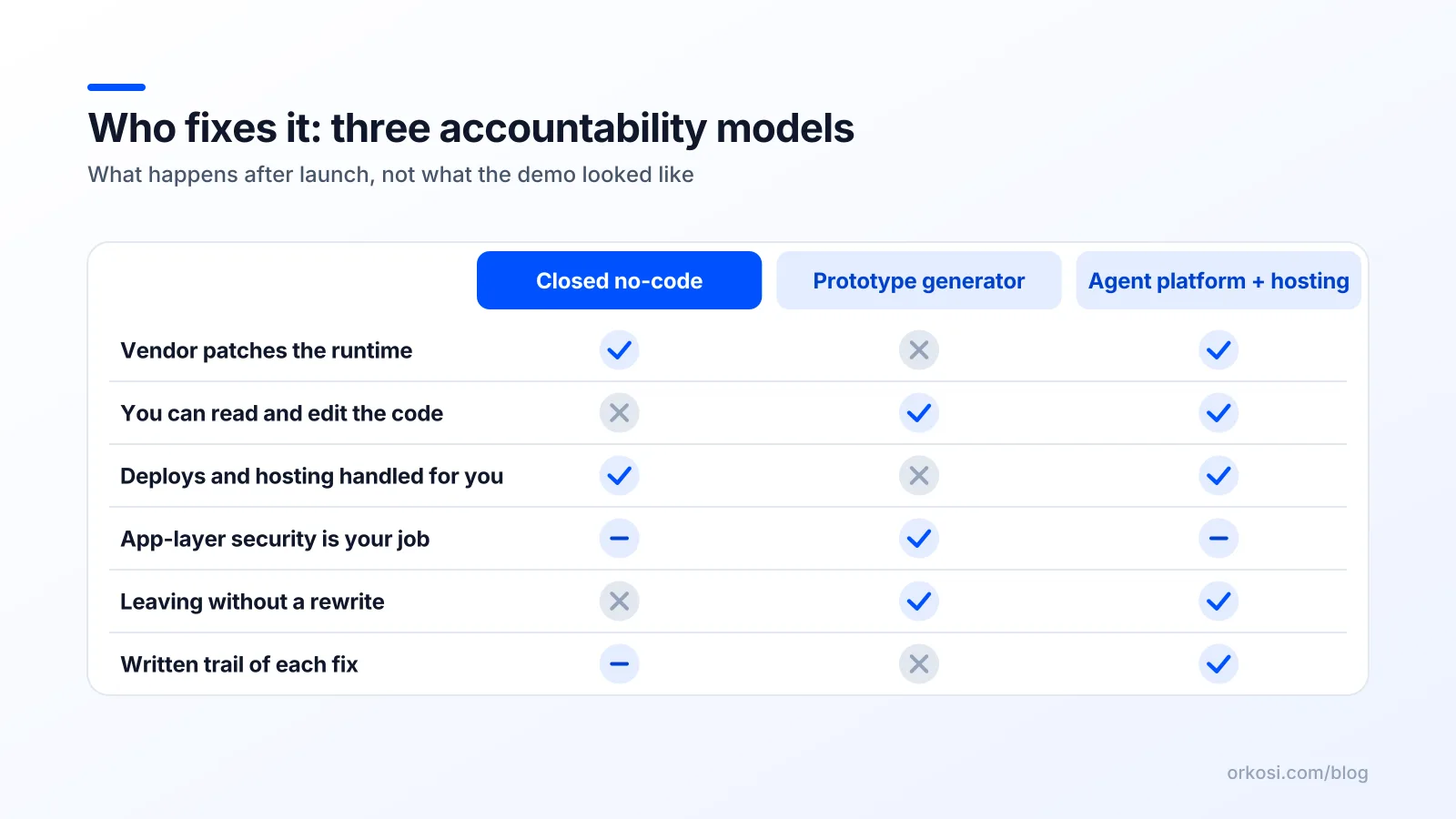
| Closed no-code platform | Prototype generator | Agent platform with hosting | |
|---|---|---|---|
| Who patches dependencies | Vendor, invisibly | You, if you remember | Vendor infra plus agent tasks you request |
| Who fixes an app-layer bug | Vendor, on their schedule | You | You direct, agent implements |
| Do you get the source code | No | Yes | Yes |
| Outage transparency | Status page, often vague | You own the logs | Depends on platform; check the docs |
| Worst case | Vendor outage you cannot touch | 3 a.m. and no engineer | Agent fixes the symptom, not the cause |
| Exit cost | Full rebuild | None | Low if you hold the repo |
Closed no-code platform: they fix it, you can't
The trade is real and sometimes correct: the vendor runs a shared platform, patches it for thousands of tenants at once, and you never think about TLS certificates. For an internal tool or a booking page, that is a good deal.
The cost arrives on the day their incident is your incident. You cannot read the stack trace, deploy a workaround, or migrate, because there is no code to migrate. Your recovery time is whatever their recovery time is.
Prototype generator: you get files and a shrug
Download-the-zip tools are honest about what they are. You own everything, which also means you own everything: hosting, secrets, certs, backups, patches, on-call.
For a founder who can read a stack trace at 3 a.m., this is the most flexible option available. For a non-technical founder, it is a product that works beautifully until the first time it does not, and then stops permanently.
Agent platform with hosting: fixes arrive as tasks
The third model keeps the agents in the loop after launch. The product is deployed, and a production bug becomes a task in the same queue as a feature request: describe it, the agent implements it, it ships.
The honest cost is supervision. An agent will happily fix the symptom you described (add a null check) rather than the cause you did not (the webhook handler is not idempotent). You still have to read the diff, or at least ask "why did this happen" before accepting the patch. You are not buying away responsibility; you are buying a much shorter path from "I know what is wrong" to "it is deployed".
Read the shared responsibility line before you build
Every one of these tools sits somewhere on the AWS shared responsibility model, whether or not the sales page mentions it. AWS is responsible for security of the cloud: hardware, hypervisor, physical data centres. The customer is responsible for security in the cloud: your data, your IAM policies, your application code, your patches. An AI app builder sits between you and that line; the question is how much of the customer side it absorbs.
Who holds the cloud account
This is the first thing to establish, because it determines everything downstream. Is the app deployed into an account the vendor controls, or one you control? Vendor-held accounts are simpler and give you less leverage. Customer-held accounts give you a hard escape hatch and a bigger surface to misconfigure. Neither is wrong. Not knowing which one you have is.
What 'managed hosting' does and doesn't cover
"Managed hosting" typically covers the infrastructure layer: server images, load balancer, TLS termination, OS packages, often database backups. That is genuinely valuable and genuinely not enough.
What it usually does not cover is your application layer: an authorisation check you never wrote, an npm package with a known exploited vulnerability, a secret committed to the repo, a migration that deletes data. Managed hosting keeps the lights on. It does not keep your access-control logic correct.
The three questions to ask any vendor in writing
Send these to support before you build anything serious. Keep the reply.
- Backups: How often are my database and uploaded files backed up, how long are they retained, and can I trigger a restore myself or must I file a request? What is the typical restore time?
- Patching: Who updates my application's dependencies when a CVE is published, and how do I find out that it happened? Is it automatic, on request, or never?
- Exit: If I cancel today, do I get a complete, runnable source repository plus a database dump, and how long do I have to retrieve them?
Vague answers to these are the answer. A vendor that cannot describe its own restore path has not tested it either.
The 3 a.m. runbook a two-person startup can actually keep
Most startup incident response plans fail because they were designed for a team of fifteen. A two-person company needs something it will still be doing in month nine.
Alerts you'll answer, not dashboards you'll ignore
Three alerts, all to a phone, all loud:
- Uptime: an external check hitting one real endpoint (not the homepage, a route that touches the database) every minute.
- Errors: an exception tracker configured to notify on new error types and on spikes, not on every occurrence.
- Billing: a notification on failed payment webhooks or failed charges, because silent revenue loss is the most expensive outage.
Everything else is a dashboard you will open twice. Resist adding a fourth alert until you have ignored one of these three for a month, which tells you it was never actionable.
One restore rehearsal before your first paying user
Do this once, before launch, and you will have a number: minutes to restore. Take a backup, restore it into a scratch environment, and open the app. Note what is missing, usually uploaded files, environment variables or the search index.
Repeat quarterly, or after any change to how data is stored. A backup you have never restored is a belief, not a backup.
Writing the fix as a task, not a panic
Google's SRE practice of blameless postmortems scales down further than most founders expect. The two-person version is a short written record per incident: what broke, how we noticed, what we changed, and what would have caught it earlier.
Then file the structural fix as a task, separately from the hotfix. The hotfix stops the bleeding at 3 a.m.; the task ("make the webhook handler idempotent and add a replay test") is what stops it happening in month seven. Without the written record, you will fix the same class of bug three times.
How Orkosi handles the day the app breaks
Orkosi sits in the third bucket: agents write the code, deploy it on AWS, and keep iterating on the live product through tasks. The relevant consequence is that there is no handoff moment where the build phase ends and you become an operations team.

Fixes as tasks on a product that's already deployed
Filing "checkout returns 500 on annual plans" works the same way as filing "add an annual plan". The agent works against the deployed codebase and ships the change, so the gap between diagnosis and deploy is not gated on finding a contractor who is awake. Hosting, the brand kit, billing and SEO tooling sit in the same place, which matters mostly because it is one fewer account to reason about during an incident. You can see the scope on the features page and the available app templates for SaaS, stores, websites, mobile and desktop.
Code you own as the real escape hatch
The strongest argument for any agent platform is also the most boring: you keep a real codebase. If Orkosi were the wrong fit in month eight, a competent contractor could read the repo and take over. That is the difference between a vendor relationship and a hostage situation, and it is worth checking for any tool you evaluate, including this one. The docs are the place to confirm the specifics.
What you still have to do yourself
Honestly: more than the marketing of this category generally implies. You decide what counts as urgent, because an agent cannot know that the broken signup page matters more than the misaligned footer. You run the restore rehearsal. You decide what "fixed" means, and whether to accept a patch that treats the symptom.
You also own the app-layer judgement calls on your side of the shared responsibility line: who can see which records, what data you collect, how long you keep it. Credits are consumed per task, so an incident has a marginal cost like anything else; see pricing for current plans and credit amounts.
A 20-minute vendor test you can run this week
Do not evaluate on the demo. Evaluate on the recovery. Pick any candidate, build something trivial, deploy it, then break it deliberately.
- Break something small, safely. Rotate or revoke an API key the app depends on. Or send your payments webhook endpoint a malformed payload with a bad signature. Or push a migration that renames a column the UI reads.
- Observe whether you found out. Did anything alert you, or did you only know because you caused it? If a deliberate break is silent, a real one will be too.
- File it the way you would at 3 a.m. One or two sentences, no diagnosis, the way a panicked founder actually writes. See what comes back.
- Time it. Minutes from report to deployed fix. Record the number.
- Check the escape hatch. Open the repository. Could a contractor find the handler, read the fix and deploy it without the platform? If you cannot locate the file, you do not own the code in any way that matters.
- Ask the three written questions from the section above and keep the replies alongside your timings.
Run this on two or three candidates and the ranking will look nothing like the one you would have produced from the demos. That is the point.
FAQ
Who is legally responsible for a security breach in AI-generated code?
You are, in almost every case. Vendor terms generally disclaim liability for application-layer flaws, and data protection law treats the business collecting the personal data as the controller regardless of who or what wrote the code. In practice the answer comes from your contract plus the shared responsibility model: the platform covers its infrastructure, you cover your data, access control and application logic.
Do AI app builders patch dependencies automatically?
Some patch the infrastructure and runtime; far fewer patch your application's package manifest without being asked. Ask explicitly and get the answer in writing, because CISA's Known Exploited Vulnerabilities Catalog grows continuously and an unpatched package is the most common avoidable path into a small product. On an agent platform you can usually file "update dependencies and fix any breakage" as a recurring task, which works, but only if someone remembers to file it.
What's the minimum monitoring a solo founder needs?
Three phone alerts: an external uptime check on a database-touching endpoint, an error tracker that notifies on new or spiking exceptions, and a notification on failed payments or failed payment webhooks. Add a quarterly restore rehearsal and you have covered the majority of incidents that kill early products.
Can I move my app off an AI app builder after launch?
It depends entirely on whether you receive a complete, runnable repository and a database export. With both, migration is a normal engineering job of days to weeks; without them, "migration" means rebuilding from scratch. Confirm the export path before you build, not when you want to leave.
Pick one candidate, build something small and break it on purpose this week. You can start free and check pricing if you want to run the test on Orkosi.