How to Run a SaaS on AWS Without DevOps on the Payroll
Orkosi Team · · 9 min read
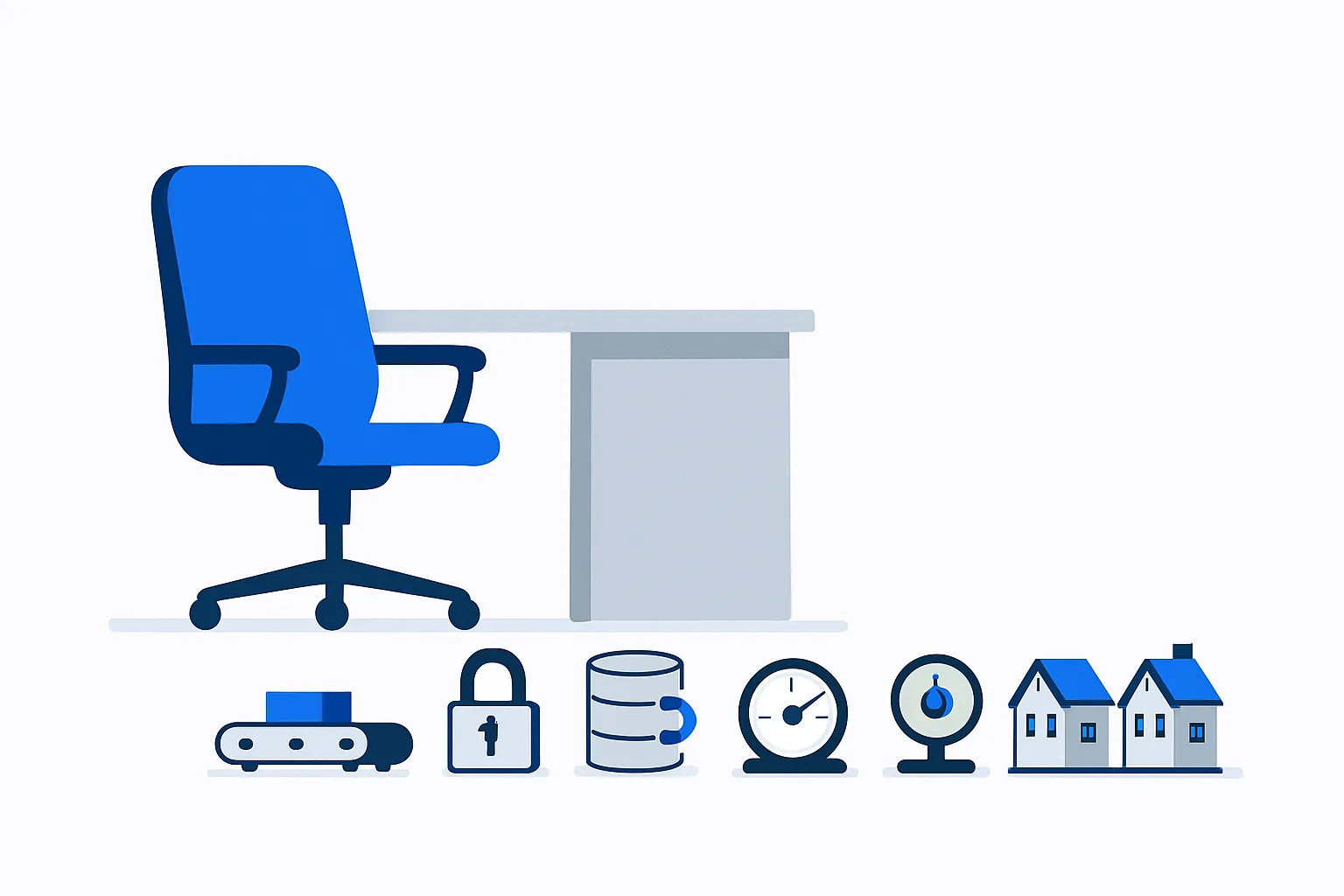
You can run a SaaS on AWS without DevOps on the payroll if the six jobs a DevOps engineer does are done by something else: environments, deployments, TLS and domains, backups, monitoring, and cost control. For a product with hundreds to a few thousand users those jobs are repetitive and well understood, which is why managed platforms exist. The choice is between a platform that does them for you, such as Heroku, Vercel or Orkosi, and doing them yourself with AWS's own managed services. This article lists the jobs, shows what good looks like for each, compares the managed options with public prices, and is clear about the point where you should hire an engineer anyway.

The six jobs DevOps does for a SaaS
Strip the job title down and a DevOps engineer on a small product spends their time on six recurring tasks. Each one is a question you must be able to answer, whoever answers it.
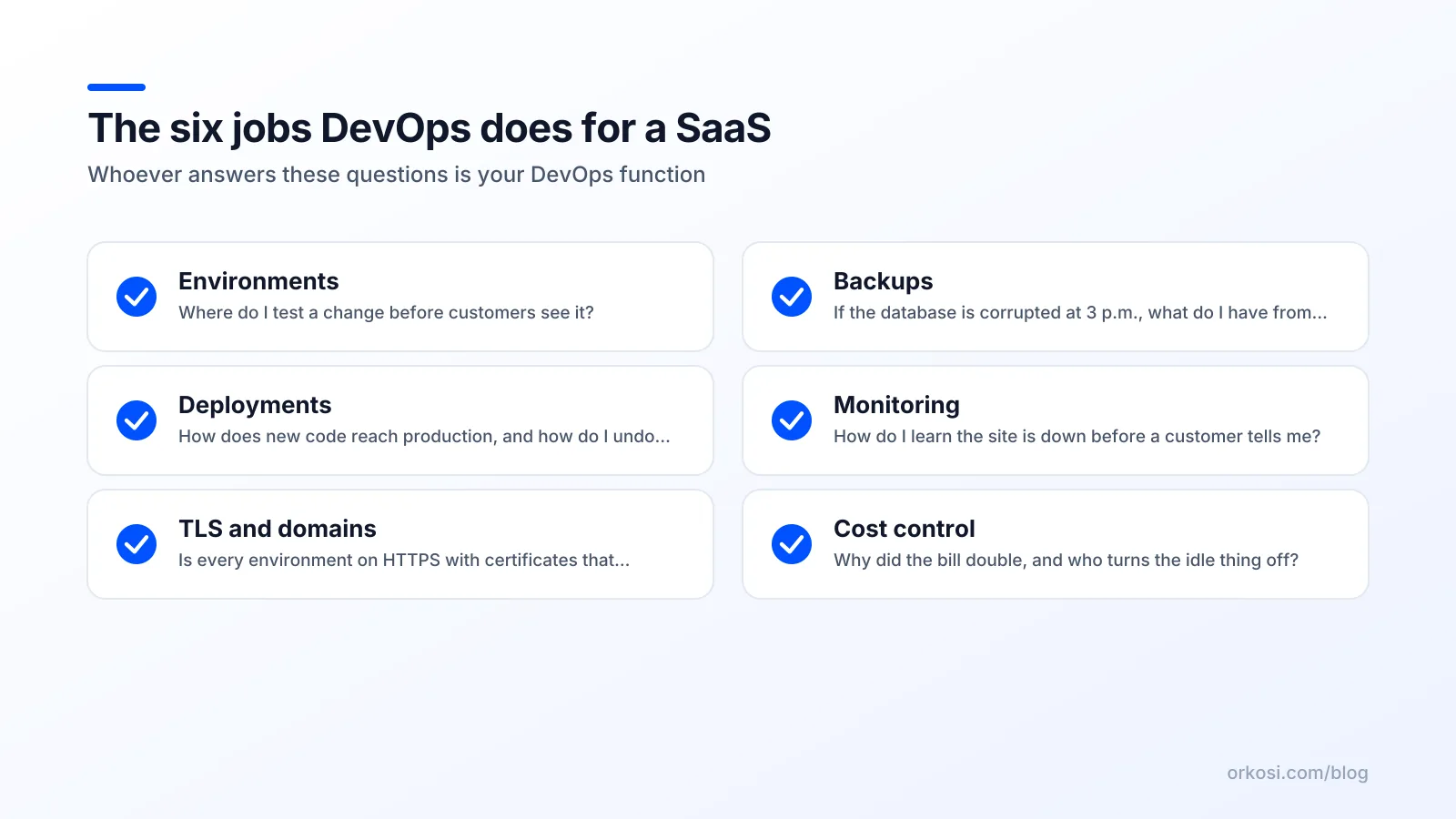
| Job | The question it answers | What happens when nobody does it |
|---|---|---|
| Environments | Where do I test a change before customers see it? | Changes are tested on customers |
| Deployments | How does new code reach production, and how do I undo it? | Deploys are manual, slow and feared |
| TLS and domains | Is the site on HTTPS with a certificate that renews itself? | Browser warnings; an expired certificate on a Sunday |
| Backups | If the database is corrupted at 3 p.m., what do I have from 2 p.m.? | Data loss becomes company loss |
| Monitoring | How do I learn the site is down before a customer tells me? | Customers are the monitoring |
| Cost control | Why did the bill double, and who turned the idle thing off? | Surprise invoices; idle resources forever |
Job by job: what good looks like
Environments
Two is the minimum: a dev environment that mirrors production closely enough to catch mistakes, and production itself. Each needs its own database and its own secrets. Preview environments per branch are a luxury that becomes a necessity once two people ship on the same day.
Deployments
A good deploy is boring: it runs the tests, builds once, releases without downtime, and can be rolled back in a minute. It happens many times a week, triggered by a merge, with no one typing commands on a server.
TLS and domains
Every environment on HTTPS, certificates issued and renewed automatically, DNS under your control, and redirects from the bare domain and from HTTP configured once. On AWS this is Certificate Manager plus Route 53 plus a load balancer or CloudFront. Done by hand it is an afternoon; forgotten, it is an outage.
Backups
Automated daily snapshots and point-in-time recovery for the database, a retention window you have chosen deliberately, and, crucially, a restore you have actually performed once. Amazon RDS includes automated backups with the instance, with backup storage up to the size of your database at no extra charge and longer retention priced per GB-month on the same page.
Monitoring
Uptime checks from outside, error tracking inside the app, log retention long enough to debug last week, and alarms that reach a phone. The standard is that you learn about an outage within a minute or two, before support does.
Cost control
A budget with alerts, resources tagged by environment, a monthly review of the bill by service, and the discipline to delete what you are not using. Our earlier article on what a small SaaS costs on AWS walks through the typical lines and the four leaks behind most surprise invoices.
What the AWS bill looks like when the jobs are done right
AWS prices everything pay-as-you-go, and for a small SaaS the headline is reassuring if the architecture is sensible.
- Compute. AWS Lambda includes 1 million free requests a month and bills per request and per millisecond of execution after that, so an API with modest traffic costs a few dollars a month. Container services bill per vCPU-hour and GB-hour instead and cost more, but still a modest monthly figure for a small product.
- Database. RDS bills per instance-hour plus storage; the smallest instances are in the low tens of dollars a month, and the AWS Free Tier covers some usage in the first year.
- Files. S3 stores data for cents per GB-month, so uploads and assets for a small product are a rounding error.
- Delivery. CloudFront has an always-free allowance of 1 TB of data transfer out a month, which keeps most small products' delivery cost at zero and absorbs what would otherwise be egress charges.
The infrastructure, in other words, is not the expensive part. The expensive part is the person who sets it up and keeps it running, which is the whole reason to ask how to run a SaaS on AWS without DevOps rather than how to run it without AWS.
How a platform lets you run a SaaS on AWS without DevOps
A product platform takes the six jobs and does them the same way for every product, which is what makes them cheap. Orkosi is one example: each product the agents build gets a dev and a production environment, hosting on AWS, TLS and a custom domain, and a database. Changes ship through a pipeline that runs automated tests and a review gate before deploying, and the agents keep working after launch through tasks the customer approves. The customer never logs into the AWS console; the feature list and the documentation describe what is covered.
The trade-offs are real. You accept the platform's architecture rather than designing your own, you do not get a global edge network of the kind Vercel runs, and if you need an unusual service (a GPU job, a specialised database) you are outside what the platform does by default. For most products with accounts, billing and a web interface, those are acceptable limits.
The managed alternatives: Heroku and Vercel
If you have written the application yourself, or someone has, two established platforms do the operations without a full AWS build-out. Both publish prices, checked 2026-10-08.
Heroku runs your code in managed dynos with pipelines for review apps and staging, and a large add-on marketplace. On the public grid it covers environments, hosting, TLS and domains and code in your GitHub repository; the database is a paid Postgres add-on and Heroku CI is an add-on. Dyno prices per month on the vendor page, checked 2026-10-08: $5 for Eco, $7 for Basic, $25 for Standard-1X, $50 for Standard-2X, $250 for Performance-M and $500 for Performance-L, each per dyno; databases are priced separately.
Vercel deploys frontends from a git push to a global edge network, with a preview deployment per branch. On the grid it covers environments, hosting and TLS; databases are marketplace add-ons and there is no built-in billing. Prices on the vendor page, checked 2026-10-08: $0 a month for personal, non-commercial use on Hobby, and $20 a month per developer seat, with a usage credit of the same amount and usage-based resources on top, on the Pro plan; Enterprise is custom.
| Capability | Heroku | Vercel | Orkosi |
|---|---|---|---|
| Writes the application code | No | No | Yes |
| Dev and production environments | Yes (review apps and pipelines) | Yes (preview deployments per branch) | Yes |
| Hosting, TLS and a custom domain | Yes | Yes | Yes |
| Database included | Partly (paid Postgres add-on) | Partly (marketplace add-ons) | Yes |
| Tests and a review gate before a change ships | No (Heroku CI is an add-on) | No (your CI) | Yes |
| Global edge network | Not in the grid | Yes | No |
| Add-on marketplace | Yes | Not in the grid | No |
| Stripe plans and subscriptions built in | No | No | Yes |
An honest summary: if you already have code and a developer, Heroku's pipelines and Vercel's preview workflow are established, well documented and quick to adopt, and both are strong where Orkosi is not (the add-on ecosystem, the edge network). If you do not have the code yet, or no one to operate it, a platform that writes and runs the product closes the gap they leave. The Heroku comparison and the Vercel comparison carry the full grids.
When you still need a DevOps engineer
Platforms let you run a SaaS on AWS without DevOps for the common case. Hire, or contract, when one of these is true:
- Compliance with evidence. SOC 2, ISO 27001 or HIPAA audits require someone to own controls, policies and evidence, not just infrastructure.
- Unusual workloads. GPU jobs, very large data pipelines, real-time streaming, or anything with hard latency requirements across regions.
- Scale that changes the architecture. Tens of thousands of concurrent users, multi-region failover, or a database that has outgrown a single instance.
- Custom networking. Private connectivity to a customer's systems, VPN peering, or strict data residency.
- Many services. Once you run more than a handful of independently deployed services, coordination becomes a job.
- Cost at a size where 10 percent matters. When the AWS bill is five figures a month, an engineer who cuts it by a tenth pays for themselves.
Until then, the honest answer for most founders is that a platform or a managed host does the six jobs better than a part-time generalist, because it does them the same way every day.
A one-page checklist before you decide
- Write the six questions from the first table and answer each with a name or a service.
- If more than two answers are "me, later", you need a platform or a host, not a to-do list.
- Price the whole thing: seats or plans plus database plus email plus your own hours.
- Check that you can leave: is the code in your repository and the database exportable?
- Try the free tiers. Heroku and Vercel both have entry options on their pricing pages; Orkosi has a free plan, with the paid plans on the pricing page.
Heroku is a trademark of its owner; Orkosi is not affiliated with it. Vercel is a trademark of its owner; Orkosi is not affiliated with it.
FAQ
Can I run a SaaS on AWS without DevOps at all?
Yes, for a product with a web interface, accounts, billing and a database, if a platform or managed host does environments, deploys, TLS, backups, monitoring and cost control for you. You take on DevOps when your workload, compliance needs or scale leave the common case.
Is AWS more expensive than Heroku or Vercel for a small SaaS?
Not usually at the infrastructure level: Lambda, RDS, S3 and CloudFront are pay-as-you-go with free allowances. What you pay a host or platform for is the operations work on top. Compare the total, including your time, rather than the compute line alone.
What does Orkosi run on?
Each product is deployed on AWS with a dev and a production environment, TLS, a custom domain and a database, and the agents keep improving it through tasks with a review gate. It does not offer a global edge network or an add-on marketplace; see the feature list.
When should I hire a DevOps engineer?
When you need audited compliance, unusual workloads, multi-region scale, custom networking or many services, or when the bill is large enough that a 10 percent saving pays a salary. Before that point, a platform does the six jobs more consistently than a part-time hire.
If you want the six jobs done for you from the first deploy, create a free account, describe the product, and compare the plans on the pricing page with what an engineer's time would cost.