Orkosi vs Bubble: a Bubble Alternative With Code You Own
Orkosi Team · · 9 min read
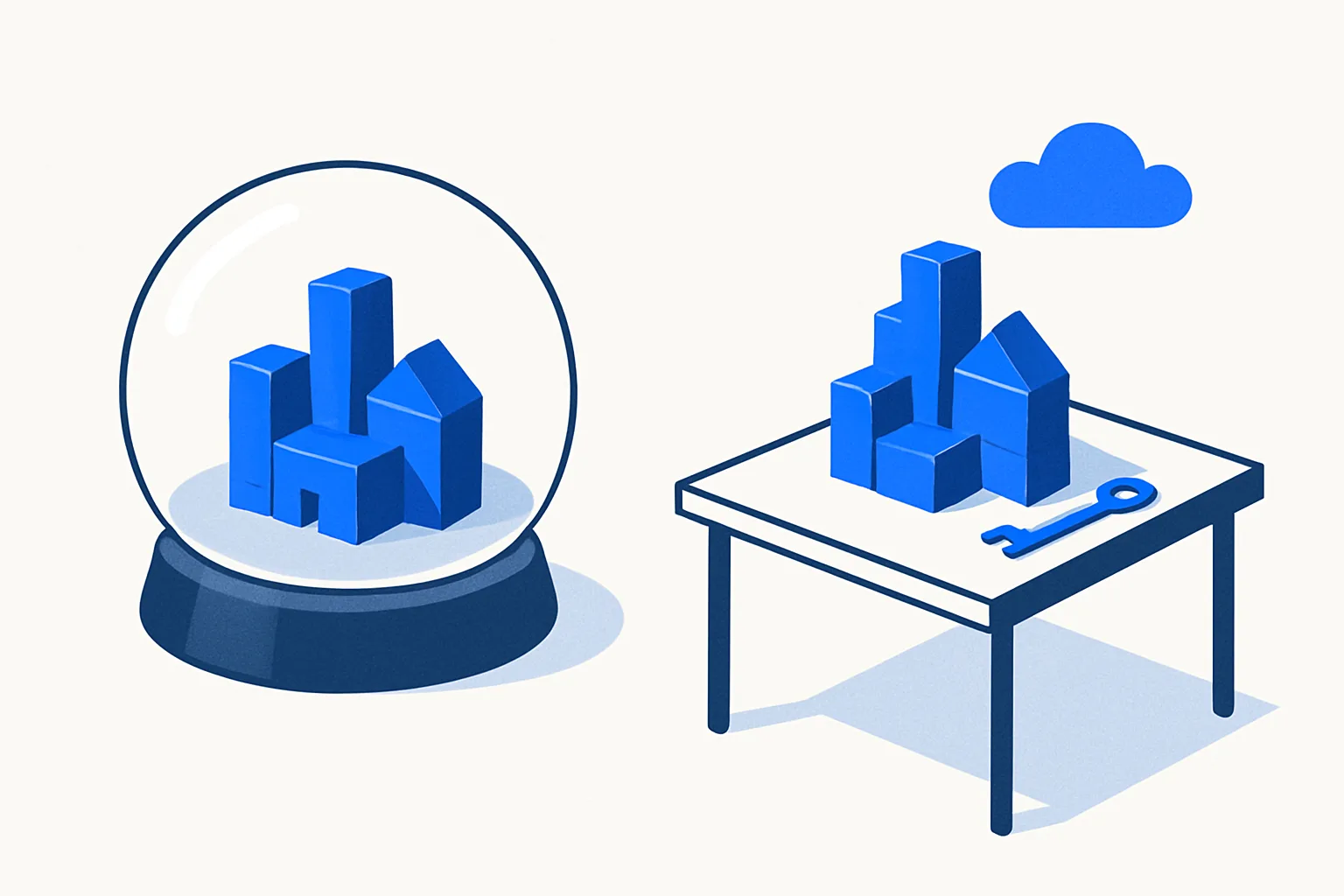
Pick Bubble if you want to build and maintain a web or native mobile app yourself in a visual editor, publish to the app stores today, and you accept that the app runs only on Bubble. Pick Orkosi, the Bubble alternative in this comparison, if you want real code in your own GitHub repository, built and maintained by agents with automated tests and a review gate, and the billing, blog and brand layer included. Bubble leads on mobile publishing and on the visual editor itself. Orkosi leads on ownership, the pipeline after launch and the business layer. The core question is who owns the runtime.

What Bubble is
Bubble is a no-code builder: a visual editor for web and native mobile apps with its own hosting and database. You design screens, data types and workflows in the browser, and Bubble runs the result. Its version control guide describes separate Development and Live versions, which the public grid lists as a full tick for environments. App-store build submissions are included per plan.
The thing to understand before anything else is in the application and data ownership page: your app and your data are yours, but there is no code export. A Bubble app runs on Bubble only. AI can generate a starting app for the visual editor, which the grid rates partial for "writes application code from a brief", because what it generates is an editor project rather than code you could run elsewhere.
Pricing, from the Bubble pricing page (checked 2026-10-08), is per app and only the annual-billed figures are in the page text: $0 for the Free plan (development version only); $59/month for the Starter plan, which is the first public tier; $209/month for the Growth plan, the next step up; $549/month for the Team plan, the top listed tier; and a custom price for the Enterprise plan. Usage is metered in workload units. Monthly-billed prices are not public in the text.
What Orkosi is
Orkosi is a platform where a team of AI agents builds, deploys and runs a software product. You describe the product in plain words; the agents write the code, deploy it on AWS with TLS and a custom domain, and keep improving it through tasks you approve. Every product lives in its own GitHub repository, has a dev and a production environment, and ships with a database, Stripe plans and subscriptions, a blog engine, a brand kit, email marketing and SEO tooling.
The output is ordinary application code. If you stopped using Orkosi tomorrow, the repository, the database schema and the deployment configuration would still be yours, and a developer could pick them up. The features page lists what is included; there is a free plan and the prices are on the pricing page.
Bubble vs Orkosi feature by feature
The grid is the one on our Bubble comparison page, checked on 2026-10-08. "Partly" means the capability exists with a limit, noted in the row.
| Capability | Bubble | Orkosi |
|---|---|---|
| Writes application code from a brief | Partly, AI generates a starting app for the visual editor | Yes |
| Agents keep working after launch through tasks | No | Yes |
| Automated tests and a review gate before a change ships | No | Yes |
| Dev and production environments | Yes, Development and Live | Yes |
| Hosting, TLS and a custom domain | Yes, custom domain from Starter | Yes |
| Database included | Yes | Yes |
| Code in your own GitHub repository | No, no code export; runs on Bubble only | Yes |
| Plans, credits and subscriptions built in (Stripe) | Partly, official Stripe plugin | Yes |
| Blog engine and brand kit | No | Yes |
| App Store publishing | Yes, store build submissions per plan | Partly, app store submission is planned; web preview today |
| Team collaboration | Partly, editors per plan | Yes |
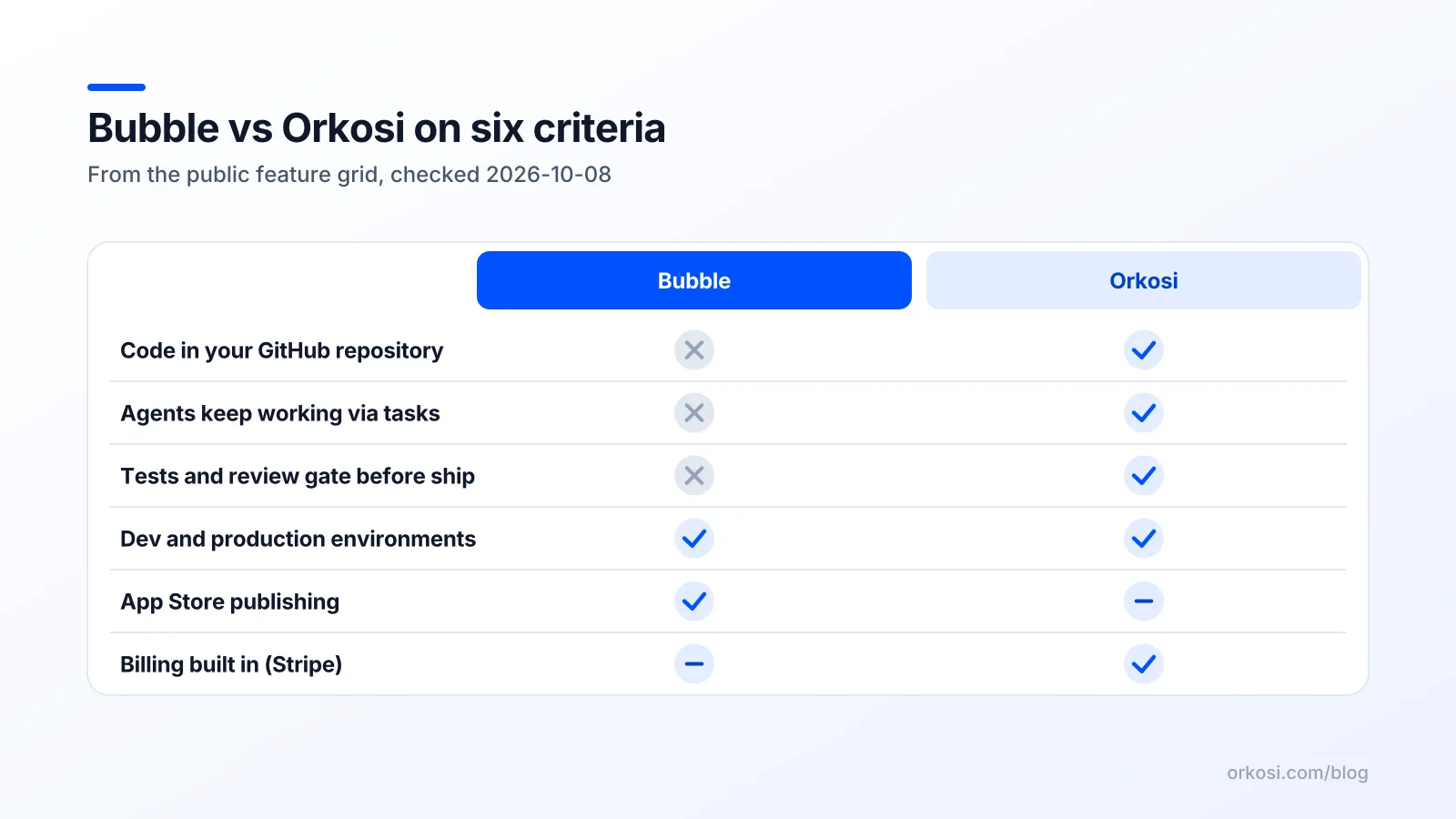
This grid is less one-sided than it looks. Bubble has a full tick for environments, hosting and a database, and it is the only tool in our comparison set that beats Orkosi on a row outright: app-store publishing. What it cannot give you is the code, and that single "No" shapes every other decision you will make.
No-code runtime vs generated code you own
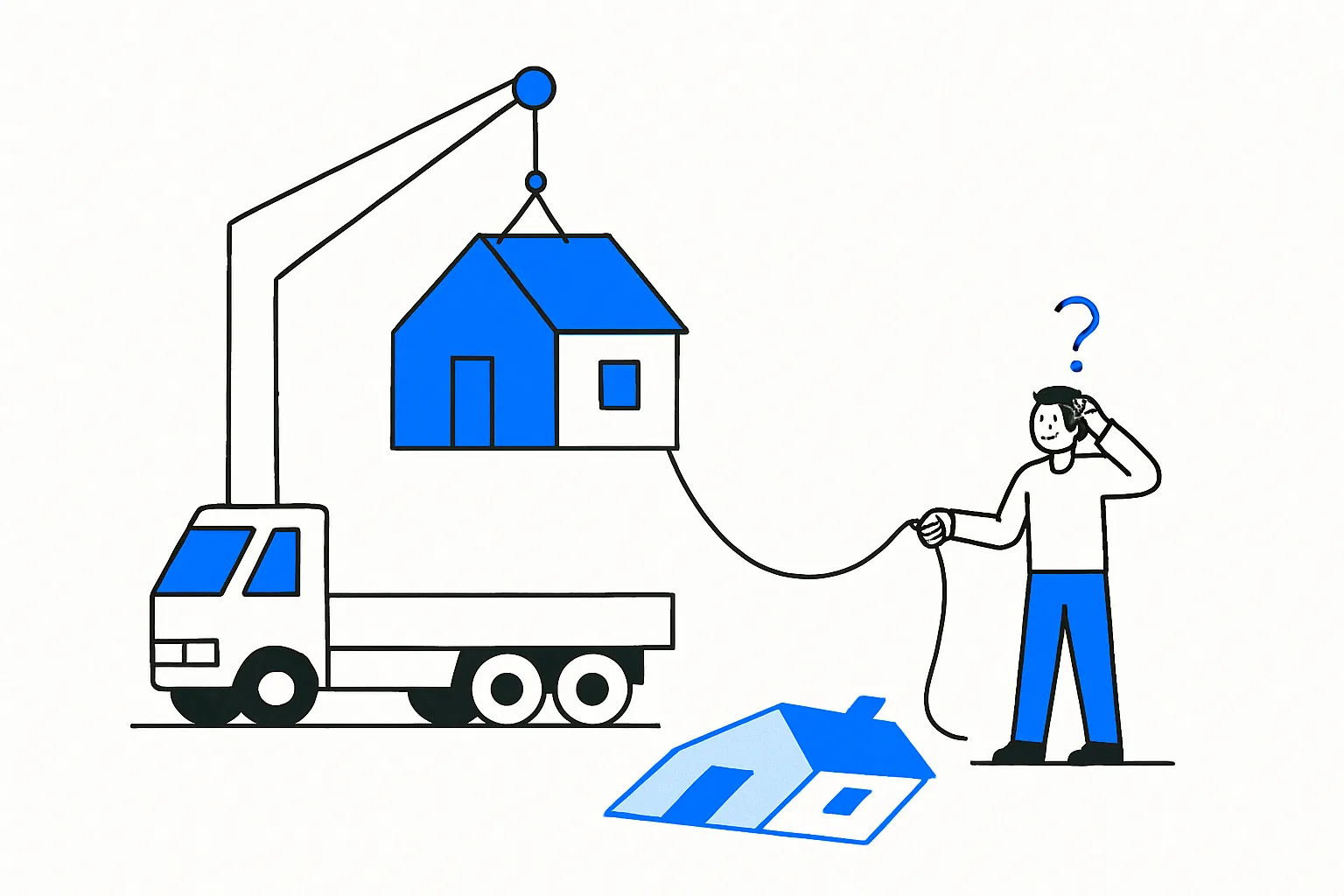
A visual builder and an AI code generator both let a non-technical founder ship a product. They differ in what exists at the end.
With Bubble, what exists is an editor project running on Bubble's servers. That is a deliberate design: it is why the editor can be visual, why hosting is automatic, and why a store build is a button. The price is that the app cannot leave. There is no code export, so switching tools means rebuilding, and your running costs are whatever Bubble charges per app and per workload unit.
With Orkosi, what exists is source code in a GitHub repository, deployed on AWS. The agents generated it, but it is the same kind of artefact a human team would produce: a schema, an API, a frontend, deployment configuration. GitHub's documentation applies to it like any other repository. A developer can read it, audit it or take it over. The price is that you review outcomes rather than drag blocks, and a vague brief produces a confidently wrong product until you correct it with a task.
Three practical consequences follow:
- Due diligence. Investors and acquirers ask for the code. A repository answers the question; an editor project does not.
- Hiring. The first developer you hire can work in a repository on day one. On a visual builder, they learn the builder.
- Exit cost. Leaving Orkosi means taking your repository elsewhere. Leaving Bubble means rebuilding.
None of this makes Bubble wrong. It makes it a rental, and rentals are fine when the term is short or the thing rented is not the business.
Pricing with sources
Bubble (vendor pricing page, checked 2026-10-08, annual-billed figures only, per app): $0/month for the Free plan, development version only; $59/month for the Starter plan, the first public tier; $209/month for the Growth plan, the next step up; $549/month for the Team plan, the top listed tier; the Enterprise price is not public. Usage is metered in workload units. Source: bubble.io/pricing.
Orkosi has a free plan. The plans and credit prices are on the pricing page and are not quoted here, because they are set in the product rather than in an article.
Two things to notice. Bubble's Free plan is a development version only, so a public app starts at $59/month billed annually, and that is per app. A founder running two products pays twice. Workload units add a usage line on top. Payments go through Bubble's official Stripe plugin, rated partial on the grid; on Orkosi, plans and subscriptions are built in. Stripe's own transaction fees apply to both and are on the Stripe pricing page.
Where Bubble leads
A fair Bubble alternative article has to be clear about where Bubble is the better choice, and the first point is a big one.
Native mobile apps in the stores, today. Store build submissions are included per plan. Orkosi generates Expo apps and has store submission planned, with a web preview today. If your product is a mobile app and a store listing is milestone one, Bubble is ahead and it is not close.
A visual editor you control. Some founders want to see and move every element themselves. Bubble's editor is built for that, and Orkosi has nothing equivalent; you write tasks and review results.
Development and Live out of the box. Two environments are a full tick on Bubble, level with Orkosi and ahead of most AI chat builders.
Hosting and a database with zero decisions. Both tools include these, but Bubble's are inseparable from the editor, which for a founder who never wants to hear the word "deployment" is a feature.
Where Orkosi leads
You own the code. Every product is a GitHub repository. Bubble's grid entry is a flat "No": no code export, runs on Bubble only.
Agents keep working after launch. A customer request becomes a task on a board; an agent builds it, a reviewer checks it, automated tests run, it deploys. On Bubble, the change is yours to make in the editor, and the grid lists no tests and no review gate.
Billing, blog and brand are included. Plans, credits and subscriptions through Stripe, a blog engine, a brand kit, email marketing and SEO tooling come with each product. On Bubble, Stripe is a plugin and the rest is built or bolted on.
Pricing you can read in one place. Bubble charges per app, from $59/month billed annually for a public one, plus workload units (vendor page, checked 2026-10-08). Orkosi's free plan and paid plans are on the pricing page; check both against the number of products you intend to run.
Team collaboration without editor seats. Collaboration is a full tick on Orkosi; on Bubble it is editors per plan.
Who should pick which Bubble alternative
Take a concrete case: a founder building a loyalty app for independent coffee shops.
If the product is the mobile app, customers scanning a code at the counter, Bubble is the right call today. Store submissions are per plan, the Development and Live split is there, and the founder maintains the app herself. She pays $59/month billed annually on Starter (vendor page, checked 2026-10-08) and accepts that the app lives on Bubble.
If the product is the shop dashboard with a monthly subscription, and the customer-facing part can be a web app for now, Orkosi fits better. The agents build the dashboard with subscriptions wired to Stripe, the code sits in her repository, each shop's request becomes a task that is reviewed and tested before it ships, and an Expo app is generated alongside it, with app-store submission planned rather than available today.
The split:
- Choose Bubble if you are a non-technical founder who wants a visual editor to build and maintain web and native mobile apps, you need the stores now, and running on Bubble is acceptable for the life of the product.
- Choose Orkosi if you want real code you own, built and maintained by agents, with a review gate and the business layer included, and your first milestone is a web product with paying customers.
- Decide on the runtime first. Ask whether, if the product works, you want to own it. If yes, a visual builder is a migration you will do later. The comparison hub covers the other tools founders shortlist, and the docs explain how an Orkosi build starts.
Bubble is a trademark of its owner; Orkosi is not affiliated with it.
FAQ
Is Orkosi a Bubble alternative for someone who cannot code?
Yes. Both are built for founders without an engineering team. Bubble gives you a visual editor and expects you to use it; Orkosi gives you a task board where agents build, review and deploy, and you write tasks in plain words. The difference is whether you want to operate the tool or supervise the work.
Can I export my app from Bubble?
Not as code. Bubble's ownership page says your application and data are yours, and the public grid records no code export; the app runs on Bubble only. Data can be worked with inside Bubble, but moving the app itself to another platform means rebuilding it.
Which is cheaper?
Bubble's first public plan is $59/month billed annually, per app, with usage metered in workload units; the Free plan is a development version only (vendor page, checked 2026-10-08). Orkosi has a free plan and the paid plans are on the pricing page. Count per-app fees and workload units on one side against credits on the other.
Which is better for a native mobile app?
Bubble, today. Store build submissions are included per plan. Orkosi generates Expo apps and has app-store submission planned, with a web preview for now. If the stores are your first milestone, that row decides it.
Want code you own, built and run by agents? Start on the free plan, then compare plans on the pricing page once you know how often the product will change.