v0 Alternative: From UI Prototype to a Running Product
Orkosi Team · · 9 min read

Anyone searching for a v0 alternative usually wants one of two things, and they are not the same product. If you want a polished interface fast, v0 is hard to beat: describe a screen, get a Next.js app, push it to GitHub and let Vercel deploy it with a preview URL for every branch. If you want a product that customers log into and pay for, you need what v0 does not include: a database, accounts, Stripe billing, a review gate, monitoring, and someone to keep building after launch. This article compares v0 and Vercel with a full product platform such as Orkosi, using public prices and a feature grid, and is honest about where v0 wins.

What v0 does well, and where it leads
v0 is Vercel's generative UI builder. You type what you want ("a pricing page with three tiers and a toggle for annual billing") and it returns Next.js code that you refine in a chat. According to the v0 FAQ, projects sync to GitHub, and on the public grid that sync is available on the Free plan.
Two things put v0 ahead of most tools in its category. The first is focus: it is built for UI generation, and on the grid that is exactly what it does (UI and Next.js apps), so the interface work that eats the first week of a project is where it saves the most. The second is the deployment experience. Because v0 deploys to Vercel, each branch gets a preview deployment and production is a merge away, with TLS and a custom domain handled for you.
If your team already writes its own backend, or you are building a frontend for an API that exists, you do not need a v0 alternative. You need v0, a GitHub repository and a Vercel project. The v0 comparison page has the grid in full.
The gap between a prototype and a product
A prototype proves that a screen can exist. A product proves that a stranger can sign up, pay, use it on a Tuesday night, and still find their data on Wednesday. The distance between the two is almost entirely backend and operations work:
- Data. Tables, migrations, backups, and a connection that survives a deploy. On the public grid v0 lists no included database (via integrations) and Vercel offers databases as marketplace add-ons.
- Accounts. Registration, login, password reset, sessions, and the emails that go with them.
- Billing. Stripe products and prices, checkout, webhooks that keep subscription state correct, invoices and failed-payment handling. Neither v0 nor Vercel lists built-in Stripe plans and subscriptions on the grid; you wire Stripe Checkout yourself.
- Two environments. Somewhere to test a change before customers see it. Vercel's preview deployments per branch cover the frontend well.
- A gate. Tests and a review before a change ships. On Vercel this is your own CI; on v0, GitHub checks and pull request review apply if you set them up.
- Operations. Logs, alarms, cost control and the person who reads them.
None of this is a criticism of v0. It was built to be the first mile, and it is a very good first mile. The problem starts when a founder treats the prototype as 80 percent of the work. In practice the interface is closer to 20 percent of a product that takes payments.
v0 and Vercel pricing, side by side
Both products publish their prices. The figures below come from the vendor pages, checked 2026-10-08, and exclude VAT and GST where the pages say so.
| Price | Plan | What the page says |
|---|---|---|
| $0/month (vendor page, checked 2026-10-08) | v0 Free | Daily message limit |
| $30 per user/month (vendor page, checked 2026-10-08) | v0 Plus | Per user |
| $100 per user/month (vendor page, checked 2026-10-08) | v0 Business | Per user |
| Not public | v0 Enterprise | Custom |
| $0/month (vendor page, checked 2026-10-08) | Vercel Hobby | Personal, non-commercial |
| $20 per developer seat/month (vendor page, checked 2026-10-08) | Vercel Pro | Usage-based resources on top, after a usage credit of the same amount as the seat |
| Not public | Vercel Enterprise | Custom |
For a solo founder shipping a commercial product, the realistic combination is $50 a month in seats, before any usage, database or email, for the v0 Plus plan plus the Vercel Pro plan. That is reasonable money. The cost that appears on neither page is the backend and operations work, whether you do it yourself or pay someone.
Orkosi prices differently: a plan with credits that covers the agents, hosting on AWS, the database, billing and two environments. There is a free plan to start, and the current figures are on the pricing page. Whether that works out cheaper depends on how much backend you would otherwise build, which is the real question behind any v0 alternative search.
Feature grid: v0 plus Vercel against a full product platform
The table merges the public grids for v0 and Vercel and sets them against Orkosi. "Partly" means the capability exists with the condition noted in the grid.
| Capability | v0 | Vercel | Orkosi |
|---|---|---|---|
| Writes application code from a brief | Yes (UI and Next.js apps) | No | Yes |
| Dev and production environments | Yes (branch previews and production on Vercel) | Yes (preview deployments per branch) | Yes |
| Hosting, TLS and a custom domain | Yes (deploys to Vercel) | Yes | Yes |
| Database included | No (via integrations) | Partly (marketplace add-ons) | Yes |
| Code in your own GitHub repository | Yes (GitHub sync on Free) | Yes | Yes |
| Plans, credits and subscriptions built in (Stripe) | No | No | Yes |
| Tests and a review gate before a change ships | Partly (GitHub checks and PR review apply) | No (your CI) | Yes |
| Agents keep working after launch through tasks | No (chat-driven per project) | No | Yes |
| Blog engine and brand kit | No | No | Yes |
| Global edge network | Not listed | Yes | No |
| Team collaboration | Partly (Plus and above) | Yes (per seat) | Yes |
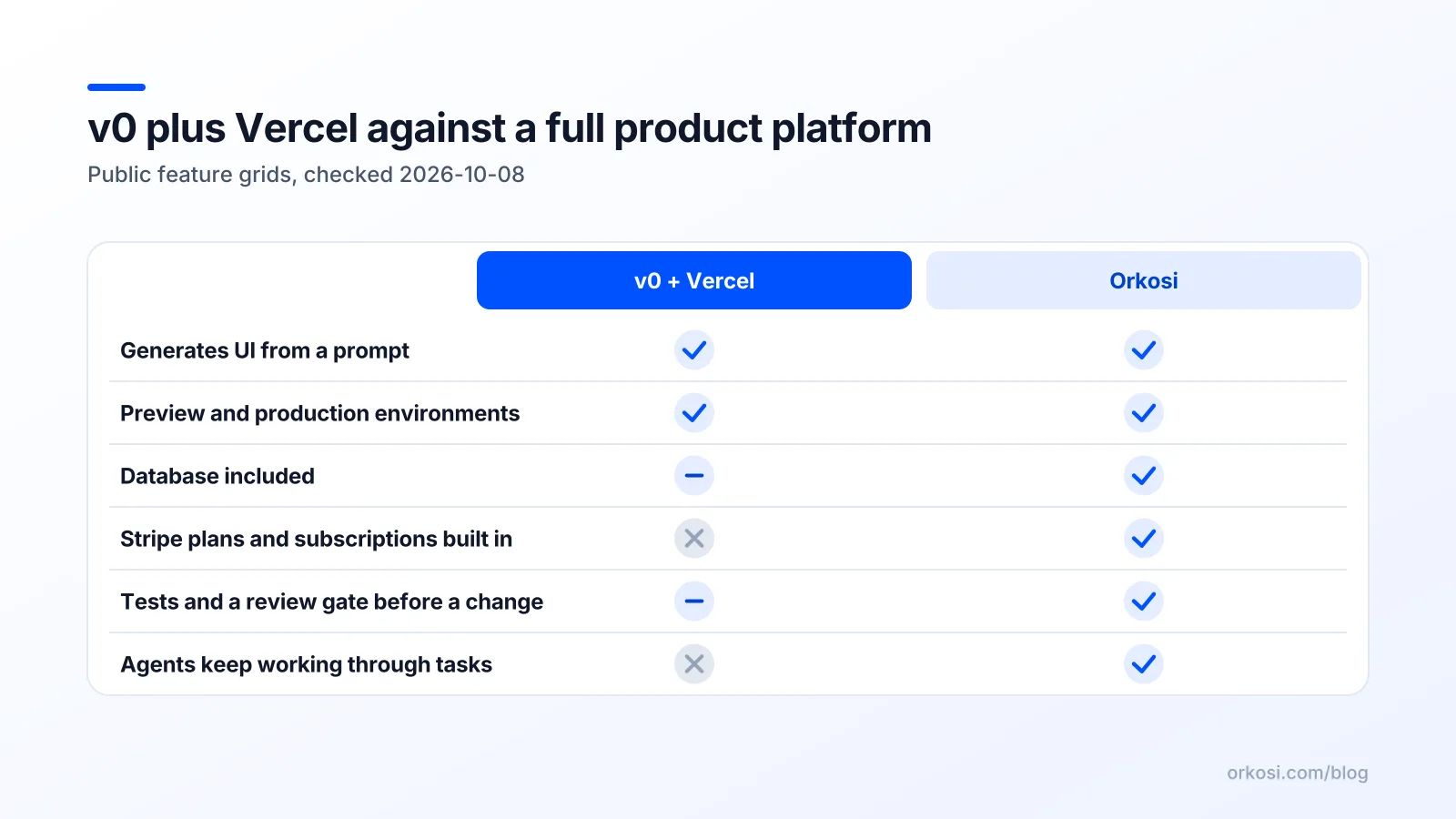
Read the grid from the bottom up. Vercel's global edge network is a real advantage that Orkosi does not have. v0's focus on UI generation is a real advantage too. Where the full platform pulls ahead is everything from the database row downwards: the parts that make a prototype into a business, and the parts that keep costing time after launch.
Three paths from a v0 prototype to production
Suppose you have a v0 prototype of a scheduling tool and a handful of people who said they would pay. There are three ways forward.
Path one: build the backend yourself
Keep v0 for the frontend, add a database from a Vercel marketplace add-on or a provider of your choice, write the API routes, wire Stripe Checkout and webhooks, set up CI, and run it. This is the right path if you are a developer and enjoy the work. Expect the backend, billing and operations to take several times longer than the interface did.
Path two: hire the backend
Hand the prototype to a freelancer or an agency. The v0 output is a useful specification because it shows exactly what each screen does. Costs vary by region and scope; what stays constant is that every change after launch is another engagement, and operations (who answers the alarm at 2 a.m.) still needs an owner.
Path three: a platform that builds and runs the product
Describe the product in plain words and let a team of agents build the backend, billing, environments and tests, deploy to AWS and keep working through tasks you approve. This is Orkosi's model. You keep ownership: every product lives in its own GitHub repository, so the v0 interface can be a starting point rather than thrown away. The trade-off is that you give up the Vercel deployment experience and the edge network, and you work through a task board instead of a chat window. The feature list describes what is included.

When a v0 alternative is the wrong move
Be honest about your situation before switching tools.
Stay on v0 and Vercel if any of these is true: your team already runs a backend and only needs interfaces; you are prototyping to test demand and might throw the result away; you need Vercel's preview workflow for a design-heavy site; or your product is content and forms rather than accounts and billing. In those cases a v0 alternative adds machinery you do not need, and you would pay for agents to build things you already have.
Consider a full product platform if these sound familiar: the prototype is done and the "real" work has stalled; you have paying users waiting on billing, accounts or a database; you have no one to own operations; or you expect to ship changes weekly for years and want each one tested and reviewed before it goes live. See the Vercel comparison for the hosting side of that decision.
A short decision list
- Write down what the product must do on day one that a screen cannot do alone: accounts, payments, stored data, emails. If the list is empty, v0 is enough.
- Decide who runs it. Name the person who handles deploys, backups and alarms. If there is no name, pick a platform that does operations.
- Check ownership. On the grid, v0, Vercel and Orkosi all keep code in your GitHub repository; confirm it for any other tool you consider.
- Price the whole stack, not the seat. Add the database, email, billing work and your own hours to the v0 and Vercel seats.
- Try before you commit. v0 has a free plan with a daily message limit, and Orkosi has a free plan too; build the same small feature on each and compare what you have after one afternoon.
v0 is a trademark of its owner; Orkosi is not affiliated with it. Vercel is a trademark of its owner; Orkosi is not affiliated with it.
FAQ
Is v0 only for frontends?
v0 generates UI and Next.js apps, and Next.js can include server routes, so small backends are possible. The public grid lists no included database and no built-in Stripe plans or subscriptions, so anything beyond the interface is integration work you do yourself or with another service.
Can I keep my v0 code if I move to a v0 alternative?
Yes, if the alternative works from a GitHub repository. v0 syncs projects to GitHub on the Free plan, and Orkosi builds every product in its own GitHub repository, so the interface can be carried forward rather than rebuilt. Expect some rework where the UI must talk to a new backend.
Does Orkosi deploy to Vercel?
No. Orkosi deploys products on AWS with a dev and a production environment, TLS and a custom domain. If Vercel's edge network or preview workflow matters to you, that is a genuine reason to stay on Vercel; the Vercel comparison page lists the trade-offs side by side.
What does a v0 alternative cost?
It is $30 per user a month for v0 Plus, and $20 per developer seat a month plus usage for the Vercel Pro plan (vendor pages, checked 2026-10-08). Orkosi has a free plan and paid plans with credits; the current figures are on the pricing page and the right plan depends on how often you ship changes.
If you have a prototype and need the rest of the product, create a free account, describe what the screens should do, and compare the result with the plans on the pricing page.