No-Code vs AI-Generated Software: Rate of Change Decides
Orkosi Team · · 12 min read

Picking between no-code vs AI-generated software is usually framed as a question of budget or technical skill. It isn't. Both routes will get a working first version in front of users this month, for less money than a single developer-week, so cost and speed cancel out. The variable that actually decides it is how often the product will change after launch, and how deep those changes cut.

No-code vs AI-generated software: the comparison everyone gets wrong
No-code platforms are hosted runtimes with visual logic. You assemble screens, workflows and database tables in a browser, and the vendor executes them on infrastructure you never see. Bubble, Glide, Softr and Airtable interfaces all work this way. You own the configuration; the vendor owns the execution.
AI-generated software means an agent writes real source code (React, Node, Python, SQL, Terraform) that you deploy to infrastructure under your own account. The agent is the author, not the runtime. When it stops, the product keeps running.
Two different bets, not two tools
No-code is a bet that your product's logic will stay inside the platform's abstractions. AI-generated code is a bet that you can tolerate owning a real codebase, including its dependencies, its bugs and its deploy pipeline.
Those bets fail differently. A no-code bet fails all at once, the day you hit something the platform cannot express, and the only fix is rebuilding elsewhere. A code bet fails gradually, through accumulated mess, and the fix is refactoring. Gradual failure is cheaper.
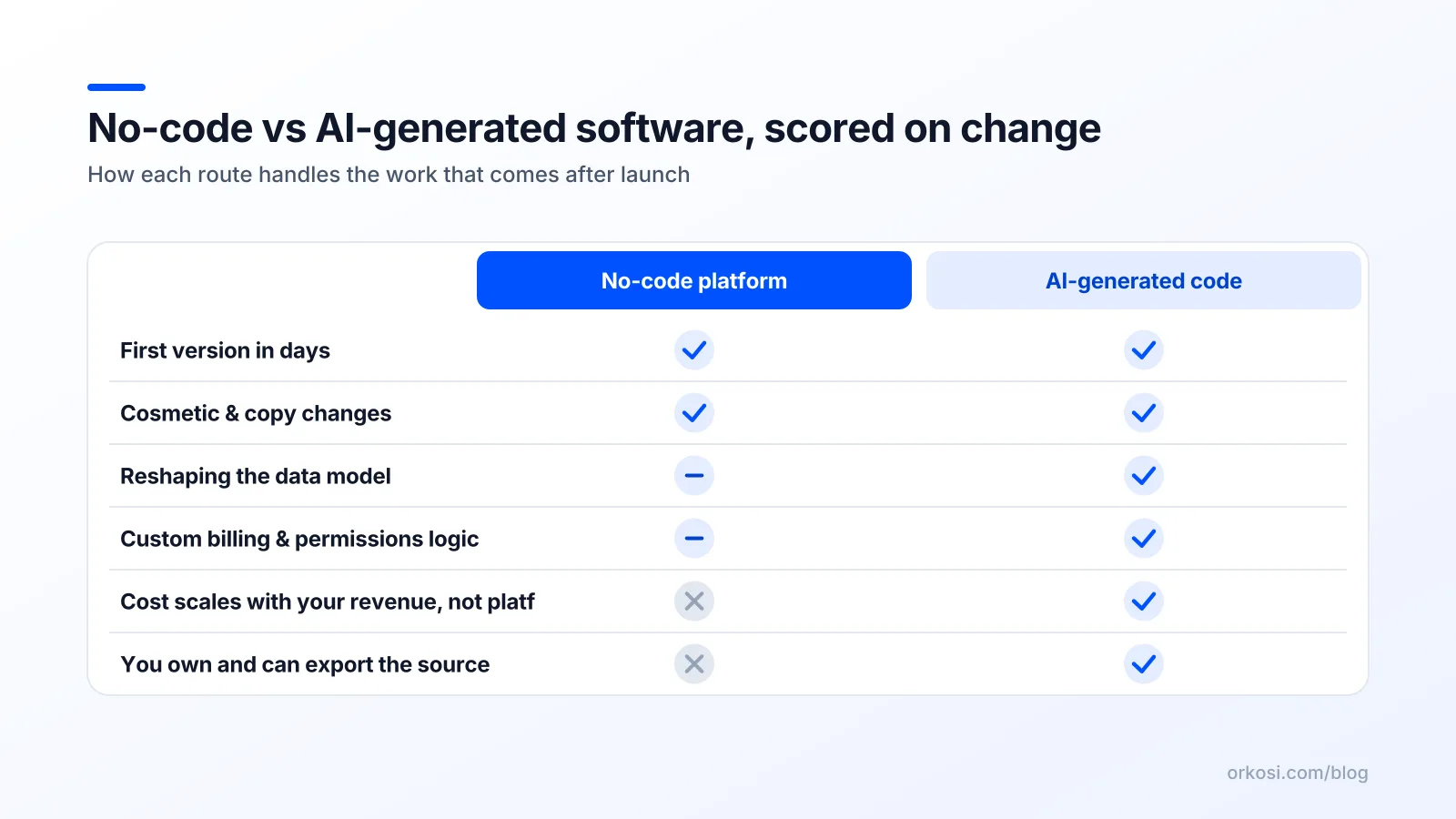
Why cost and speed are the wrong tie-breakers
Time-to-first-version is roughly equivalent now. A competent no-code builder ships a CRUD app in a weekend; a capable coding agent ships one in an afternoon. Monthly cost at small scale is also comparable: tens of dollars either way.
So stop comparing the launch. Compare change number 50. On a no-code platform, change 50 might be a support ticket, a plugin purchase, or a migration. In code, change 50 is the same motion as change 1: edit files, test, deploy.
| Criterion | No-code platform | AI-generated code |
|---|---|---|
| First version | Days | Hours to days |
| Cosmetic change | Trivial | Trivial |
| Data model reshape | Risky, sometimes manual | Migration script |
| Deep integration (e.g. billing edge cases) | Connector limits apply | Fully expressible |
| Who answers a security questionnaire | The vendor | You, with real logs |
| Exit cost | Full rebuild | Change of hosting |
Rate of change: the metric nobody asks about
Define it precisely: rate of change is the number of meaningful product changes you expect per month across the first 12 months after launch. Meaningful excludes copy tweaks and colour changes. It includes anything that touches logic, data or integrations.
Under 2 per month is low. Two to six is moderate. Above six, you are iterating weekly, and your stack choice is really a choice about iteration friction.
How to estimate yours in 20 minutes
Write down the next 10 changes you genuinely expect, not the ones on a roadmap slide. Then tag each one:
- Cosmetic — layout, copy, branding, a new static page.
- Logic — pricing rules, permissions, notification conditions, workflow branching.
- Data model — a new entity, a relationship change, a field that becomes a table.
- Integration — a third-party system you need to read from or write to with real error handling.
Count how many fall in the last three buckets and divide by the months you think it will take. That is your rate of change. If seven of ten are logic, data model or integration, you have answered the question already.
Change rate vs change depth
Frequency and depth are different risks. Fifty cosmetic changes a month are fine on any platform. Two data model reshapes a quarter can be fatal on the wrong one.
This is not a novel idea; it's the industry standard framing. DORA's research on software delivery performance has spent a decade showing that high-performing teams optimise deployment frequency and lead time for change, the time from committed change to running in production. Elite performers deploy on demand and measure lead time in hours. Founders are choosing a stack on exactly that axis whether they realise it or not, so they may as well do it deliberately.
Where no-code genuinely wins (and I'd use it)
I would not build an internal expense tracker in code. It would be a waste of effort and a liability to maintain.
Low change rate, short lifespan, internal audience
No-code wins decisively when the change surface is small, the logic is shallow, and nothing downstream depends on your data model. That describes a lot of real software:
- Forms, applications and intake flows
- Internal trackers and lightweight CRMs
- Approval and sign-off workflows
- Event registration and ticketing for one event
- Campaign microsites and one-off tools with a known end date
The common thread: these things get built, used, and then either abandoned or left alone. A tool with a six-month lifespan and a change rate near zero does not need a repository.
Workflow glue and ops tooling
Stitching SaaS apps together is where no-code is not just adequate but correct. Zapier's pricing starts free and its paid tiers are priced per task, which makes shallow automation genuinely cheap. Writing and hosting the same webhook relay yourself costs more in attention than it ever saves in fees.
The rule I use: if the logic fits in one sentence with at most one "if", automate it. "When a Typeform is submitted, create a Notion row and send a Slack message" should never be a codebase.
Where AI-generated code wins: anything you intend to iterate on
If you plan to ship weekly, build in code. Every change becomes an edit to a file rather than a negotiation with someone else's abstraction, and the agent that wrote change 1 can make change 40 the same way. That covers most commercial products: SaaS tools, marketplaces, anything with multi-tenant permissions, anything where pricing is part of the product rather than a line item.
Custom pricing, permissions and data models
Pricing logic is where no-code abstractions bend first. Seat-based plus usage-based with a free allowance, annual discounts, grandfathered legacy plans and a partner tier is not exotic; it's a normal second year. Each of those is a conditional branch over a metering table.
Permissions follow the same pattern. "Admins see everything" is easy everywhere. "Account owners see billing, managers see their team's data but not salaries, and auditors see read-only history across all teams" is a row-level security model. You want that expressed in code you can test, not in a visual rules panel you have to re-read every time it changes.
Integrations that go deeper than a connector
Billing is the canonical example. A connector handles the happy path: checkout completed, subscription created. The remaining 20% is where the money is.
Read Stripe's webhooks documentation and notice what production handling actually requires: verifying signatures, processing events out of order, idempotency so a retried delivery doesn't double-provision an account, handling invoice.payment_failed with a dunning sequence, and reconciling against the API because webhooks can arrive late. No-code connectors cover event one and event two. Products need all of them, and a failed payment that silently leaves a cancelled customer with access is a revenue bug you find in month nine.
AI code generation is credible here precisely because this logic is well-documented and heavily patterned. The Stack Overflow Developer Survey 2024 found roughly three-quarters of developers using or planning to use AI tools, while trust in the accuracy of the output remained mixed. That split is the right mental model: strong at producing conventional implementations, weak as an unreviewed oracle. Treat generated code as a fast first draft of a known pattern, verified against the vendor's docs.
The four changes that break no-code first
In roughly the order founders hit them.
Data model reshaping
Month three, a "field" becomes an entity. Your customer.address text field needs to become a table with multiple addresses, each with a type and a validity window. In code, that's a migration and a few query changes. On a hosted platform, it can mean manual data surgery, broken references across dozens of visual workflows, and no dry run.
Integration depth
Month five, you need a partner's API that has no connector. You can often call it over HTTP from a no-code tool, but the surrounding machinery is missing: retries with backoff, queueing, dead-letter handling, structured logs you can grep when a sync silently stops.
Performance and pricing cliffs
Month eight, growth arrives and unit economics invert. Usage-metered no-code pricing is the mechanism: Bubble's pricing meters workload alongside plan tiers, so heavy background jobs and chatty pages consume capacity whether or not they generate revenue. A batch job that recalculates something for every user can cost more than the users pay. You cannot optimise the runtime because you don't own it; you can only upgrade or delete the feature.
Compliance and audit requests
Month eleven, your first serious enterprise buyer sends a questionnaire. It asks about data residency, encryption at rest, access logs, subprocessors, penetration test results and source code review. Those answers belong to your platform, not to you, and "our vendor is compliant" is a weaker answer than "here is our region, our logs and our architecture". When the deal is worth more than the rebuild, you rebuild.
The afternoon test: pick with five changes, not five opinions
Stop debating low-code vs AI agents in the abstract. Run this instead; it takes an afternoon.

Write the five changes
List the five changes you expect in months two to six. Be specific and concrete. "Add a second pricing tier with a 14-day trial and proration on upgrade" counts. "Improve onboarding" does not.
Score each route
For each change, score both routes: trivial (under an hour), workaround (possible but awkward, plugin, external service, manual step), or blocked (needs a different platform). Score honestly, and check the platform's docs rather than guessing.
Read the score honestly
Any blocked in months two to six means build in code now. Three or more workarounds means the same, because workarounds compound into a system nobody can modify.
Worked example, a booking tool for a two-person studio. Five changes: add a second service type, change cancellation window, add a deposit, email reminders, embed on a new site. Zero blocked, one workaround (deposit). No-code is fine; change rate is one or two per month and nothing downstream reads the data.
Worked example, a usage-billed B2B analytics app. Five changes: metered billing with overage, SSO for one enterprise customer, per-team row-level permissions, a public API with rate limits, and audit logs with 12-month retention. Three blocked, two workarounds. Build in code. This is the clearest case of when to use no-code vs custom code, and the answer is not ambiguous.
The hybrid path, and the migration tax nobody budgets
The strongest counter-argument: validate in no-code, rebuild in code once you have traction. It's a legitimate strategy and sometimes the right one. It is also systematically under-priced.
Validate in no-code, build in code
The hybrid works when the no-code version is deliberately disposable, with few users, no paying customers depending on continuity, and a question it exists to answer. "Will plumbers pay for this?" is a question a throwaway app can answer in three weeks.
It stops working when the prototype gets customers. Then you're maintaining a product and building its replacement at the same time, with one team.
What migration actually costs you
Migrating off no-code is not an export. Budget for:
- Rebuilt logic. Visual workflows don't convert; every rule gets re-specified from scratch, and some rules only exist in someone's memory.
- Data export fidelity. CSV exports lose relationships, computed fields and file attachments. Reconciliation is manual.
- Re-integrating payments. New Stripe customer and subscription mapping without double-charging or dropping access mid-cycle.
- Re-doing auth. Password hashes often cannot be exported, which means forced resets and measurable churn.
- Frozen roadmap. Several weeks to a few months of shipping nothing new while competitors ship.
The hybrid is defensible only if you write the migration trigger down before you start. Pick one: a user count, a monthly revenue figure, or the first blocked change from the afternoon test. Without a written trigger, the decision defaults to "not yet" until it becomes an emergency.
How Orkosi handles high-change products
Orkosi sits on the AI-generated code side, deliberately. You describe the product, agents write real source code, deploy it on AWS, and keep iterating through tasks, so change number 50 is the same motion as change number 1: describe it, the agent implements it, it ships.
The practical difference from assembling your own toolchain is that hosting, a brand kit, billing, SEO and marketing tooling live in the same place as the code, so you're not integrating five vendors before launch. App templates cover SaaS / Web App, Online Store, Website, Image studio, Mobile app, Desktop app and Video Channel, and the features overview explains what each includes.
Honest trade-offs. You are taking on a real codebase, which means real review, and agent output needs checking against vendor documentation on anything money-related. Work is metered in credits, so a high-change month costs more than a quiet one; the Starter, Pro and Enterprise plans on the pricing page show the current tiers, and the documentation covers how tasks and deployments work. If your five changes are all cosmetic and your product has a known end date, a no-code tool is still the cheaper answer, and you should use it.
FAQ
Is AI-generated software just no-code with extra steps?
No. The output is different in kind. No-code produces a configuration that only runs inside the vendor's runtime; AI code generation produces source files you deploy to infrastructure you control. That distinction matters the day you need something the platform doesn't support, because code can be edited and configuration can only be configured. The describing-what-you-want part looks similar; what you own at the end does not.
Can I move my data off a no-code platform later?
You can usually export rows, but migrating off no-code is not primarily a data problem. Relationships, computed fields, file attachments and password hashes often don't survive the export, and none of your visual workflows convert into anything. Expect to re-specify the logic from scratch, re-map Stripe customers and subscriptions, and force a password reset for every user. Budget weeks, not a weekend, and assume a frozen roadmap while it happens.
What change rate is low enough for no-code?
Roughly two meaningful changes per month or fewer, where "meaningful" means logic, data model or integration rather than copy and layout. Internal tools, single-event registration, intake forms and SaaS-to-SaaS automation sit comfortably in that band. Above six meaningful changes a month, iteration friction dominates every other consideration and real code wins. Between two and six, run the afternoon test and let the blocked changes decide.
Do I need a developer to maintain AI-generated code?
Not necessarily to ship changes, since the agent that wrote the code can modify it. You do need someone accountable for review on anything involving money, authentication or customer data, because the Stack Overflow 2024 survey found developer trust in AI output remains mixed even as adoption is near-universal. A practical pattern is agent-led development with a contractor reviewing security-sensitive changes monthly.
Write your five changes for months two to six, score each one trivial, workaround or blocked, and you will know which route you need. If the answer is real code, start free and check pricing for plan details.