Orkosi vs Bolt.new: a Bolt.new Alternative for Founders
Orkosi Team · · 8 min read
Pick Bolt.new if you want a website, store or dashboard out of one chat today, with hosting, a database and Stripe already wired, and you are happy to be the person who maintains it. Pick Orkosi, the Bolt.new alternative in this comparison, if you need a product that keeps being built after launch by agents working through tasks, with automated tests and a review gate before each change ships and two environments per product. Bolt is cheaper to start and quicker to a first screen. Orkosi costs more time up front and gives you a product that runs without you steering every change.

What Bolt.new is
Bolt (at bolt.new) is an AI website and app builder. You chat, it writes the code, and the result is a project in an editor you can publish as a live site. Of the chat-driven generators founders shortlist, it is the one with the most of the business plumbing already connected: the public grid lists a built-in database (Bolt Database or Supabase, per its database support page), a Stripe integration and a GitHub integration with version history.
Plans are priced in tokens rather than credits. The pricing page (checked 2026-10-08) lists $0 for the Free plan with 1M tokens a month and Bolt branding, $25/month billed monthly for the Pro plan with 10M tokens, $30/month per member billed monthly for the Teams plan, and a custom price for the Enterprise plan. Yearly billing saves up to 28 percent; the yearly figures are not in the page text. A custom domain comes with Pro.
Bolt also generates Expo projects, so mobile is on its grid as a partial capability, the same rating Orkosi has.
What Orkosi is
Orkosi is a platform where a team of AI agents builds, deploys and runs a software product. You describe the product in plain words; the agents write the code, deploy it on AWS with TLS and a custom domain, and keep improving it through tasks you approve. Every product lives in its own GitHub repository, has a dev and a production environment, and ships with a database, Stripe plans and subscriptions, a blog engine, a brand kit, email marketing and SEO tooling.
The part that separates it from a chat builder is the loop after launch. A change is a task: you write it, an agent builds it, a reviewer agent checks it, automated tests run, and only then does it deploy. The features page lists what is included; there is a free plan and the prices are on the pricing page.
Bolt.new vs Orkosi feature by feature
The grid is the one on our Bolt comparison page, checked on 2026-10-08. "Partly" means the capability exists with a limit, noted in the row.
| Capability | Bolt | Orkosi |
|---|---|---|
| Writes application code from a brief | Yes | Yes |
| Agents keep working after launch through tasks | No, chat-driven editing | Yes |
| Automated tests and a review gate before a change ships | No | Yes |
| Dev and production environments | Partly, editor project and a published site | Yes |
| Hosting, TLS and a custom domain | Yes, custom domain on Pro | Yes |
| Database included | Yes, Bolt Database or Supabase | Yes |
| Code in your own GitHub repository | Yes, GitHub integration | Yes |
| Plans, credits and subscriptions built in (Stripe) | Yes, Stripe integration | Yes |
| Blog engine and brand kit | No | Yes |
| Mobile apps | Partly, Expo projects | Partly, Expo apps generated; store submission planned |
| Team collaboration | Partly, Teams plan | Yes |
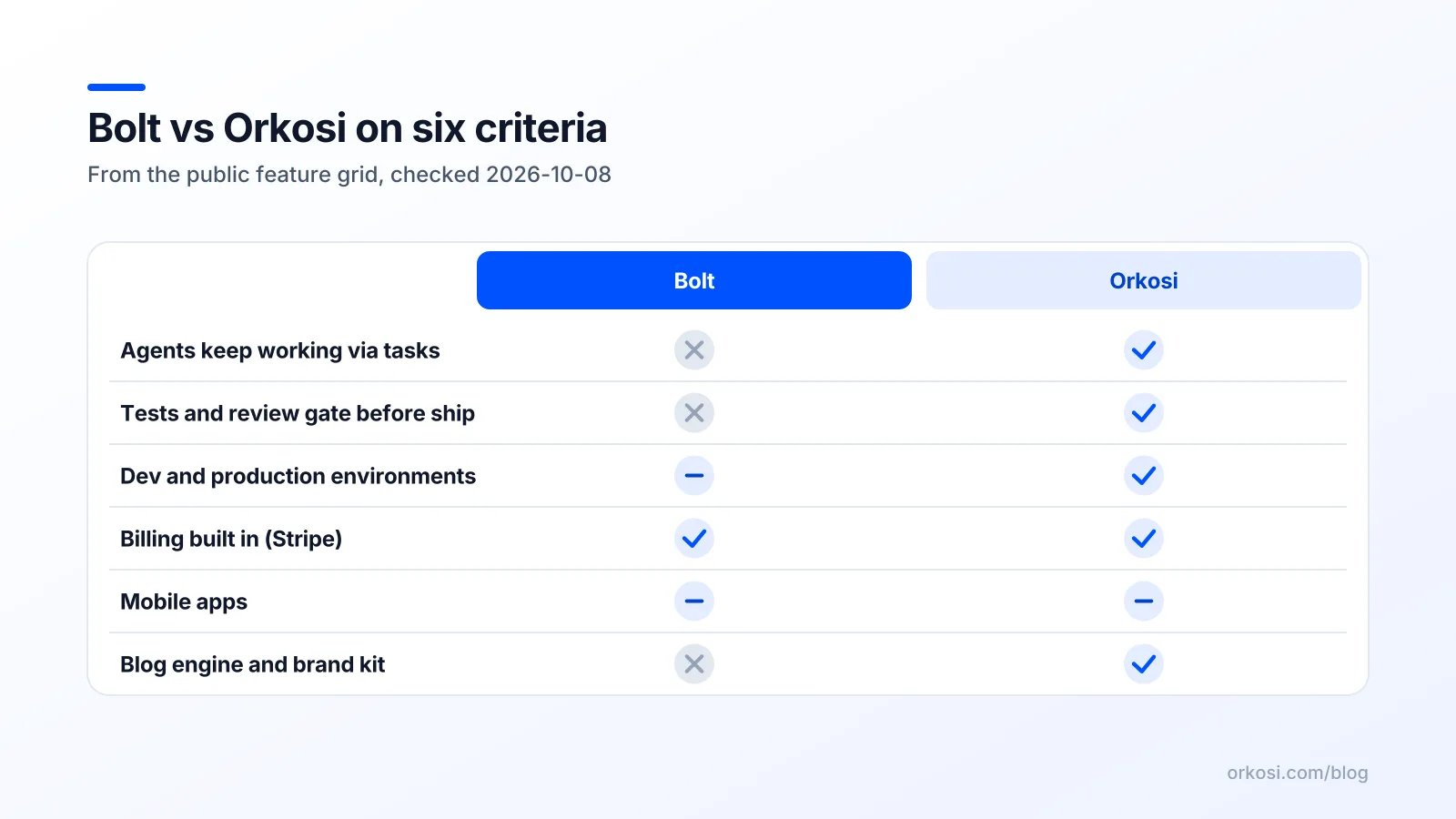
Bolt scores better against Orkosi than most chat builders because Stripe, the database and GitHub are all full ticks rather than partial ones. The rows where it does not tick are the same three rows every chat builder misses: nothing keeps working when you stop chatting, nothing checks a change before it goes live, and there is no production environment separate from the one you edit in.
Pricing with sources
Bolt (vendor pricing page, checked 2026-10-08): $0/month for the Free plan, with 1M tokens a month and Bolt branding; $25/month for the Pro plan, with 10M tokens a month; $30/month per member for the Teams plan; the Enterprise price is not public. Source: bolt.new/pricing.
Orkosi has a free plan. The plans and credit prices are on the pricing page and are not quoted here, because they are set in the product.
A note on the token model. Ten million tokens on Pro is a monthly budget that the chat consumes as it reads and writes your project, so a large codebase costs more per change than a small one. That is not a criticism, just the mechanism, and it means a growing product on Bolt tends to climb the plan ladder. Stripe's own transaction fees apply to both tools and are on the Stripe pricing page.
Where Bolt.new leads
A fair Bolt.new alternative article has to be plain about where Bolt is the better pick.
One chat, whole stack. Hosting, a database, Stripe and GitHub are all wired from the same interface. For a founder who wants a store or a dashboard live this week without touching infrastructure, that is hard to beat, and it is the reason Bolt ties Orkosi on three of the business rows.
Lowest cost to a live site. Free with 1M tokens gets you a published site with Bolt branding. Paying $25/month for the Pro plan (vendor page, checked 2026-10-08) removes the branding and adds a custom domain. There is no cheaper route from nothing to a public URL in this comparison.
Expo today. Bolt generates Expo projects now. Orkosi does too, and both carry a partial rating because neither submits to the app stores for you; Orkosi's store submission is planned. On this row Bolt is at least level and arguably ahead on maturity, which we cannot measure from the public grid, so we call it a tie.
Simplicity. There is no task board, no review step and no second environment to think about. If your product is a marketing site with a form, that simplicity is a feature, not a gap.
Where Orkosi leads
The product keeps being built. On Orkosi, a bug report or a feature request becomes a task on a board. An agent builds it, a reviewer checks it, it deploys. On Bolt, it becomes a prompt you write and a result you inspect yourself. The difference is small on day one and large by month six.
A gate before production. Automated tests and a review step run before anything ships. Chat-generated code that looks finished and is subtly wrong, a missing permission check, a date bug in a booking flow, is the common failure mode; a gate exists to catch it before a customer does.
Two environments. Dev and production are separate for every Orkosi product. Bolt's grid entry is partial: the editor project and a published site. When paying customers are on the published site, you want somewhere else to try a change first.
Content and brand included. A blog engine, a brand kit, email marketing and SEO tooling come with every product. On Bolt these are things you add or build.
Collaboration without a plan jump. Team collaboration is a full tick on Orkosi; on Bolt it arrives at $30/month per member on the Teams plan (vendor page, checked 2026-10-08).
Who should pick which Bolt.new alternative
Take a concrete case: a two-person team launching a paid directory for independent bike shops, with a listing fee and a monthly premium tier.
On Bolt, they chat the directory into shape, connect Stripe, publish for $25/month on the Pro plan (vendor page, checked 2026-10-08), and start onboarding shops. Every shop's request ("let us upload three photos", "the map is wrong in Leeds") is a prompt one of them writes, checks and publishes.
On Orkosi, they write a brief, the agents build the directory with the premium tier already wired to Stripe, and every shop request becomes a task. A reviewer checks each fix and tests run before it reaches the live site. They pay for a plan from the pricing page and spend their time on bike shops.
The split:
- Choose Bolt if you are an individual building a website, store or dashboard from one chat, you want the lowest cost to a live URL, and you are happy to be the maintainer. Marketing sites, small stores, dashboards and validation experiments fit.
- Choose Orkosi if you are a founder who wants a product built and maintained by agents, with a review gate, two environments and the business layer included. Paid SaaS products with customers who will file requests for years fit.
- Prototype on one, run on the other if you want the fastest validation and then a product that lasts. The comparison hub covers the other tools on the usual shortlist, and the blog has a longer guide to building a SaaS without writing code.
Bolt is a trademark of its owner; Orkosi is not affiliated with it.
FAQ
Is Orkosi a Bolt.new alternative for someone who cannot code?
Yes. Both start from a written description. Bolt gives you a chat and an editor; Orkosi gives you a task board where agents build, review and deploy. Neither asks you to write code, and both put the code in your GitHub repository so a developer can take over later.
Does Bolt.new include Stripe?
Yes. Its public grid lists a Stripe integration, documented on its support page, and it is a full tick, the same as Orkosi, where plans, credits and subscriptions are built into every product. The difference is what sits around the payments: Orkosi's review gate and separate production environment, versus Bolt's direct publish.
Which is cheaper to start?
Bolt. Its Free plan has 1M tokens a month with Bolt branding, and the next step is $25/month for the Pro plan (vendor page, checked 2026-10-08). Orkosi also has a free plan; the paid plans are on the pricing page. Compare total cost including the hours you will spend maintaining the product, not just the subscription line.
Can both build a mobile app?
Partly, on both. Bolt generates Expo projects; Orkosi generates Expo apps and has app-store submission planned. Neither ships to the stores for you today, so if a store listing is the whole point, look at the tools built for that first.
Want to see what agents build from your brief? Start on the free plan, then compare plans on the pricing page once you know how often the product will change.