Orkosi vs Lovable: a Lovable Alternative for Running a SaaS
Orkosi Team · · 8 min read
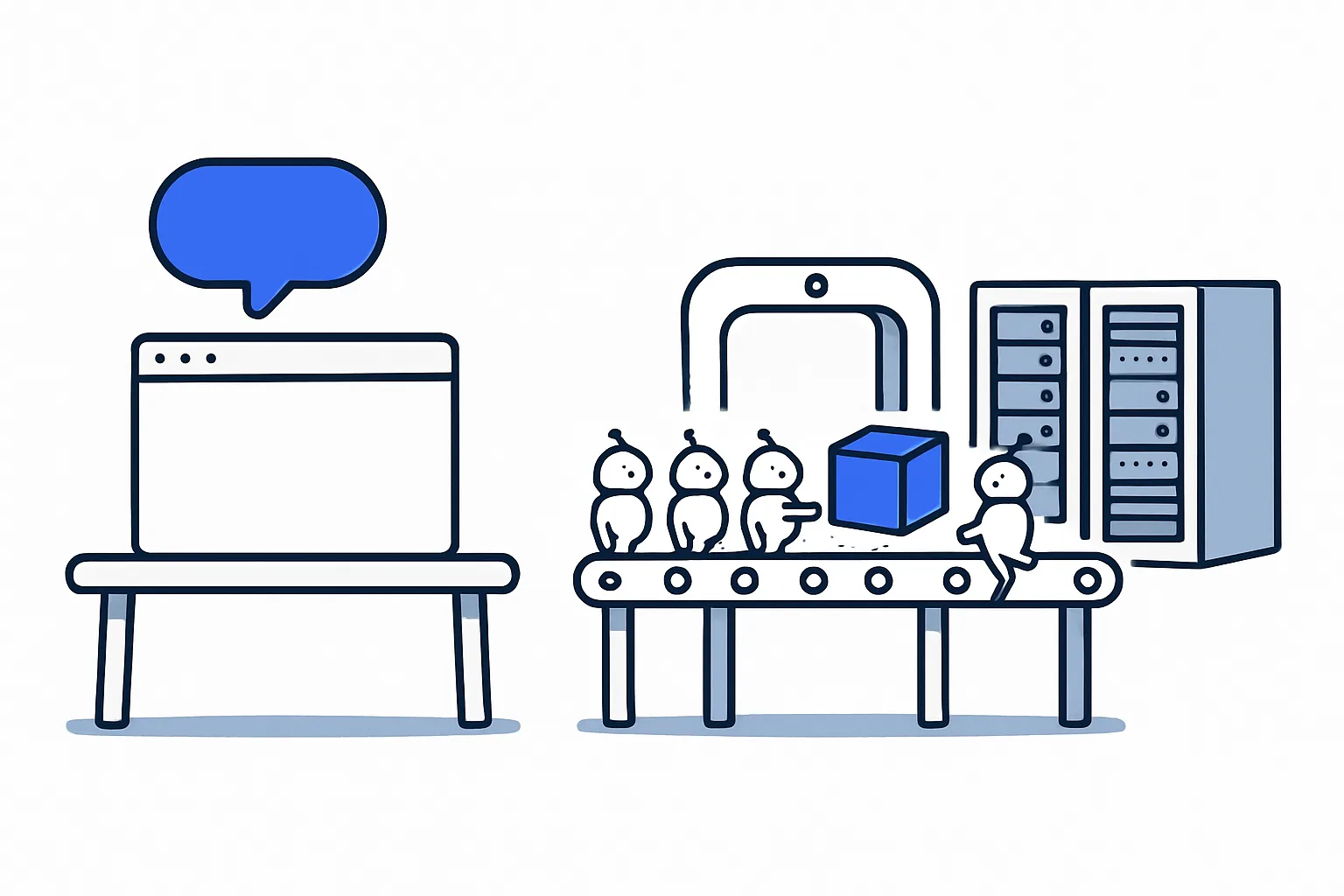
Pick Lovable if you want to prompt a web app into existence this afternoon, keep editing it in chat and own the code through GitHub sync. Pick Orkosi, the Lovable alternative this article is about, if you want a product that keeps being built after launch: a team of agents takes tasks you approve, runs automated tests and a review gate before anything ships, and hands you billing, a blog engine and a brand kit as part of the product. Lovable is cheaper to start and faster to a first prototype. Orkosi is the better fit when the product has to run as a business rather than exist as a demo.

What Lovable is
Lovable is an AI web app generator. You describe what you want in a chat, it writes the application code, shows you a live editor preview and publishes a snapshot when you are happy. Its subscription plans are priced in build credits, which you spend per prompt.
The backend is handled by Lovable Cloud, documented on its Cloud page, so a database is included without you provisioning one. Code lives in your own GitHub repository through two-way sync on every plan, including the free one, as the GitHub integration docs describe. A custom domain and built-in payments are available on paid plans.
What Lovable does not do, according to the public feature grid, is keep working on your product after you stop prompting. Every change is a chat message you write. There is no automated test run or review gate between your prompt and the published snapshot, and there is no separate production environment; you get the editor preview and the published version.
What Orkosi is
Orkosi is a platform where a team of AI agents builds, deploys and runs a software product for a founder or small business. You describe the product in plain words, the agents write the code, deploy it on AWS with TLS and a custom domain, and keep improving it through tasks you approve.
The difference in shape matters more than any single feature. On Orkosi, a change is a task: you write it, an agent builds it, a reviewer agent checks it, automated tests run, and only then does it deploy. Each product has a dev environment and a production environment, lives in its own GitHub repository, and ships with a database, Stripe plans and subscriptions, a blog engine, a brand kit, email marketing and SEO tooling. The features page lists what is included; there is a free plan, and prices are on the pricing page.
Orkosi is slower to a first screen than a chat generator, because the pipeline does more before it shows you anything. That is the trade you are making.
Lovable vs Orkosi feature by feature
The grid below is the public comparison we maintain for the Lovable comparison page, checked on 2026-10-08. "Partly" means the capability exists with a limit, noted in the row.
| Capability | Lovable | Orkosi |
|---|---|---|
| Writes application code from a brief | Yes | Yes |
| Agents keep working after launch through tasks | No, chat-driven editing per prompt | Yes |
| Automated tests and a review gate before a change ships | No | Yes |
| Dev and production environments | Partly, editor preview and a published snapshot | Yes |
| Hosting, TLS and a custom domain | Yes, custom domain on paid plans | Yes |
| Database included | Yes, Lovable Cloud | Yes |
| Code in your own GitHub repository | Yes, two-way sync on every plan | Yes |
| Plans, credits and subscriptions built in (Stripe) | Partly, built-in payments on paid plans | Yes |
| Blog engine and brand kit | No | Yes |
| Mobile apps | No, web only | Partly, Expo apps generated; store submission planned |
| Team collaboration | Yes, unlimited workspace members | Yes |
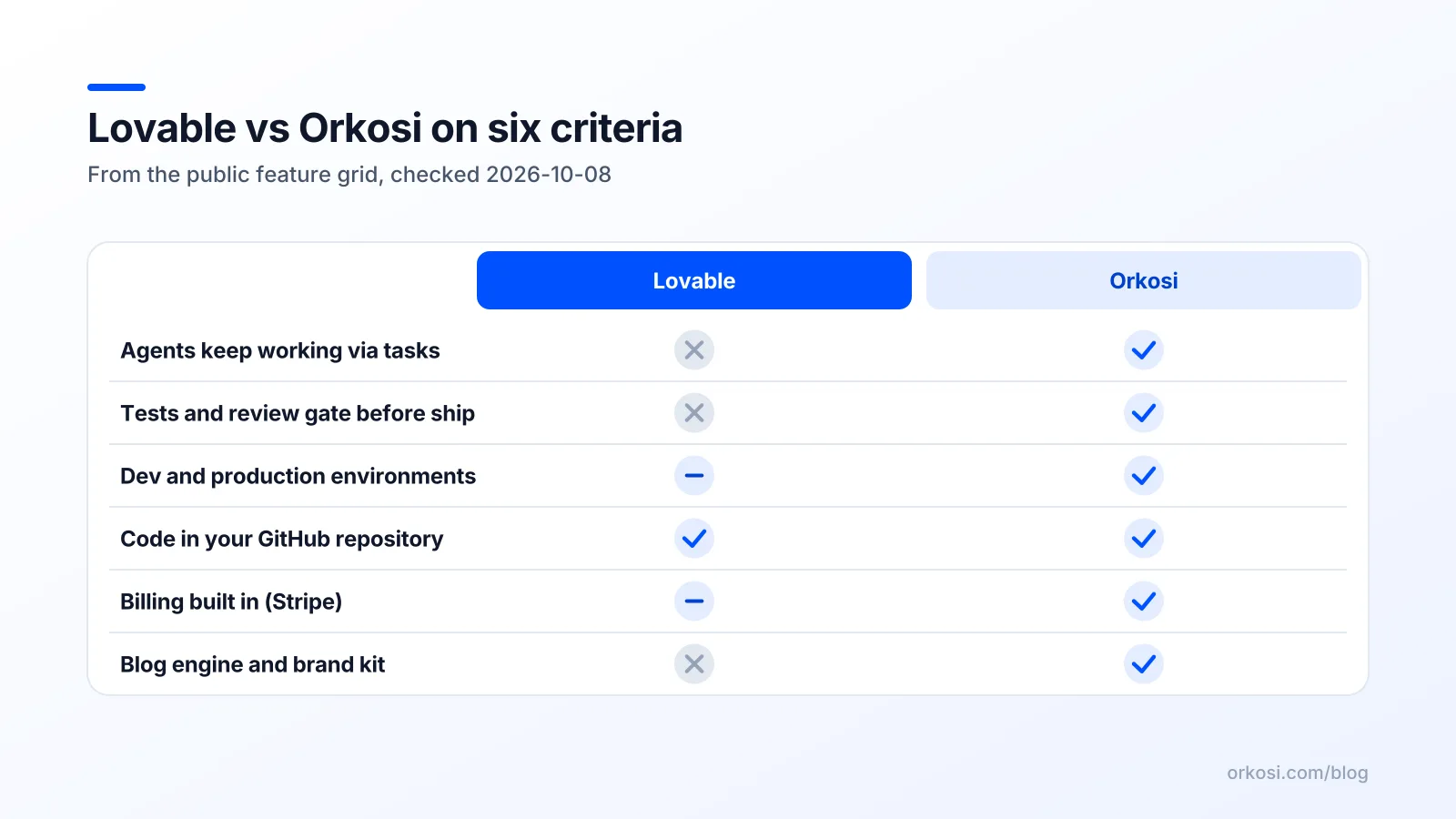
Read the table from the bottom up and the pattern is clear. On the things a prototype needs, code generation, hosting, a database and a repository, the two are level. On the things a running business needs, a review gate, a production environment separate from development, billing and content tooling, Orkosi has them built in and Lovable either offers a partial version or leaves it to you.
Pricing: what each costs to start
Lovable's plan cards render client-side, so these figures come from its documentation page, which lists the plans in plain text.
Lovable (vendor docs, checked 2026-10-08): $0/month for the Free plan, with 5 build credits a day; from $25/month for the Pro plan, with a monthly allowance of 100 credits, and higher credit tiers cost more; from $50/month for the Business plan at the entry credit tier; the Enterprise plan is volume-based and not public. Annual billing gives two months free. Source: Lovable subscription plans, with the marketing summary on lovable.dev/pricing.
Orkosi has a free plan. The current plans and credit prices are on the pricing page; this article will not quote them because they are set in the product, not in a blog post.
Two things worth noticing about the Lovable model. First, credits are per prompt, so a long back-and-forth with the chat costs more than a short one, and the 100 credits on Pro are a budget you manage. Second, payments inside your app need a paid plan, so a product that charges customers starts at $25/month before you add anything else. Stripe's own fees apply on top for both tools; the Stripe pricing page has the standard rates.
Where Lovable leads
An honest Lovable alternative article has to say where Lovable is the better choice, and there are four clear cases.
Speed to a first prototype. A chat that renders an editor preview as you type is the shortest possible loop from idea to screen. If you need something to show an investor or a customer tomorrow, Lovable gets there faster than a pipeline that tests and reviews every change.
Free tier generosity. Five build credits a day on the Free plan means you can keep experimenting at no cost for as long as you like. That is a real advantage for someone testing three ideas before committing to one.
Collaboration without seat maths. The grid lists unlimited workspace members. If a group of co-founders wants to prompt the same project, nobody is counting seats.
GitHub sync on every plan. Two-way sync including Free means you are never locked in, even before you pay. Orkosi also puts every product in its own repository, so this is a tie on ownership, but Lovable deserves credit for making it free.
Where Orkosi leads
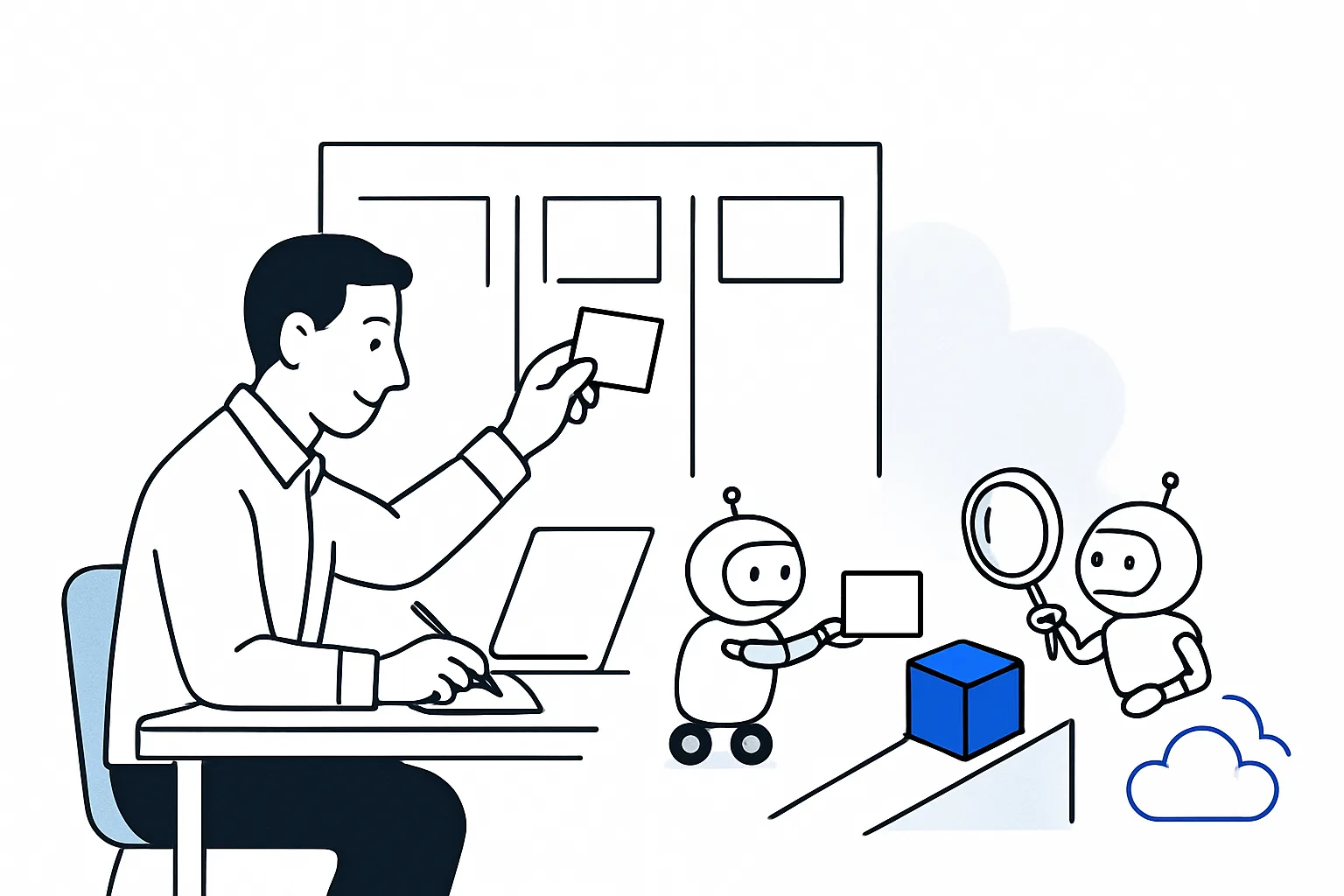
Work continues after launch. This is the structural difference. On Lovable, the product changes when you prompt it. On Orkosi, you write a task ("customers can export invoices as CSV from the Billing page"), an agent builds it, a reviewer checks it and it deploys. You approve outcomes rather than steering every edit.
A gate before production. Automated tests and a review step run before a change ships. A generated feature that looks finished but has a missing permission check is the classic failure of chat-built apps; a review gate exists to catch exactly that.
Two real environments. Dev and production are separate on Orkosi. Lovable's grid entry is partial: an editor preview and a published snapshot. For a product with paying customers, being able to test a change somewhere that is not production is not a nice-to-have.
The business layer is included. Plans, credits and subscriptions through Stripe, a blog engine, a brand kit, email marketing and SEO tooling come with every product. On Lovable, built-in payments are a paid-plan feature and the rest is yours to assemble.
Mobile is on the roadmap, not absent. Orkosi generates Expo apps today; app-store submission is planned. Lovable is web only. Neither ships to the stores for you yet, so treat this as a direction rather than a reason.
Who should pick which Lovable alternative
Take a concrete case: a physiotherapist who wants an online booking product with a monthly subscription for other clinics.
On Lovable, she prompts the booking screens, connects payments for $25/month on the Pro plan (vendor docs, checked 2026-10-08), publishes and starts selling. Every bug report from a clinic becomes a prompt she writes that evening. It works, and it costs her evenings.
On Orkosi, she writes a one-page brief, the agents build the product with subscriptions already wired, and each bug report becomes a task on a board. A reviewer checks the fix and tests run before it reaches the clinics. She pays for the plan on the pricing page and spends her evenings on clinics instead of prompts.
The split, then:
- Choose Lovable if you are an individual or small team who wants to prompt a web app into existence, iterate in chat and own the code. Prototypes, internal tools, validation experiments and products you are happy to maintain by hand all fit.
- Choose Orkosi if you are a founder who wants a product built, deployed and maintained by agents, with billing, content and a review gate included. Paid SaaS products with real customers, where you do not want to be the maintainer, fit here.
- Choose both, in sequence, if you want to validate quickly and then run properly. Prototype in a chat tool, learn what customers want, then write the brief for the product that has to last. The comparison hub covers the other tools founders usually shortlist.
Lovable is a trademark of its owner; Orkosi is not affiliated with it.
FAQ
Is Orkosi a Lovable alternative for non-technical founders?
Yes. Both tools start from a written description rather than code. The difference is what happens next: Lovable gives you a chat and an editor, Orkosi gives you a task board where agents build, review and deploy. A non-technical founder can run either; the Orkosi route asks you to write clear tasks rather than steer an editor.
Can I keep my Lovable code if I move?
Yes, because Lovable syncs to your own GitHub repository on every plan. Orkosi builds a product from your written description in a new repository rather than importing one, so the practical route is to turn what you learned from the prototype into the brief. The docs explain how a build starts.
Which is cheaper?
To start, Lovable: its Free plan has 5 build credits a day and the next step is $25/month for the Pro plan (vendor docs, checked 2026-10-08). Orkosi also has a free plan, with the paid plans on the pricing page. The comparison that matters is total cost including your time to maintain the product, which depends on how often it needs to change.
Do I own the code on both?
Yes. Lovable uses two-way GitHub sync; Orkosi creates a GitHub repository for every product. Neither locks the code inside a proprietary runtime, which is the main reason both appear on shortlists that exclude visual no-code builders.
Ready to see what a team of agents builds from your brief? Start on the free plan, and compare plans on the pricing page once you know how often your product will need to change.